
Avoiding Rework When Sourcing Resistant Dextrin and MCC in China
[data-scope=hz-36029e]article { background-color:#ffffff; padding:20px 0; }
[data-scope=hz-36029e].abstract { font-size:0.95em; font-weight:normal; font-style:italic; color:#555555; margin-bottom:30px; padding:0; border:none; line-height:1.7; }
[data-scope=hz-36029e]h2 , [data-scope=hz-36029e]h3 , [data-scope=hz-36029e]h4 , [data-scope=hz-36029e]h5 , [data-scope=hz-36029e]h6 { color:#333333; margin-top:1.5em; margin-bottom:0.8em; line-height:1.3; font-weight:600; }
[data-scope=hz-36029e]h2 { font-size:1.8em; }
[data-scope=hz-36029e]h3 { font-size:1.5em; }
[data-scope=hz-36029e]h4 { font-size:1.3em; }
[data-scope=hz-36029e]p { margin-bottom:1.2em; }
[data-scope=hz-36029e]a { color:#333333; text-decoration:none; border-bottom:1px solid #cccccc; transition:color 0.2s ease-in-out,border-color 0.2s ease-in-out; }
[data-scope=hz-36029e]a :hover { color:#000000; border-bottom-color:#000000; }
[data-scope=hz-36029e]img { max-width:100%; height:auto; display:block; margin:20px auto; border-radius:4px; }
[data-scope=hz-36029e].image-container-center img { width:80%; height:350px; object-fit:cover; object-position:center; }
[data-scope=hz-36029e].image-container-center-small img { width:80%; height:auto; object-fit:cover; object-position:center; }
[data-scope=hz-36029e]table { width:100%; border-collapse:collapse; margin-bottom:1.5em; font-size:0.9em; }
[data-scope=hz-36029e]th , [data-scope=hz-36029e]td { padding:10px 12px; text-align:left; border:1px solid #dddddd; }
[data-scope=hz-36029e]th { background-color:#f8f8f8; font-weight:600; color:#333333; }
[data-scope=hz-36029e]tr :nth-child(even) { background-color:#fdfdfd; }
[data-scope=hz-36029e]blockquote { margin:1.5em 0; padding:1em 1.5em; border-left:4px solid #eeeeee; background-color:#f9f9f9; color:#555555; font-style:italic; border-radius:4px; }
[data-scope=hz-36029e]blockquote p { margin-bottom:0; }
[data-scope=hz-36029e]ul , [data-scope=hz-36029e]ol { margin-bottom:1.2em; padding-left:25px; }
[data-scope=hz-36029e]li { margin-bottom:0.5em; }
@media (max-width:768px) { [data-scope=hz-36029e].container { padding:15px; }
[data-scope=hz-36029e]h2 { font-size:1.6em; }
[data-scope=hz-36029e]h3 { font-size:1.3em; }
[data-scope=hz-36029e].abstract { font-size:0.9em; }
[data-scope=hz-36029e]th , [data-scope=hz-36029e]td { padding:8px 10px; }
[data-scope=hz-36029e].image-container-center img, [data-scope=hz-36029e].image-container-center-small img { width:100%; height:auto; } }
@media (max-width:480px) { [data-scope=hz-36029e]h2 { font-size:1.4em; }
[data-scope=hz-36029e]h3 { font-size:1.2em; }
[data-scope=hz-36029e].abstract { font-size:0.85em; }
[data-scope=hz-36029e]table { font-size:0.85em; } }
Many procurement teams today find themselves pairing **resistant dextrin** and **microcrystalline cellulose (MCC)** in the same sourcing project—often for very different functional reasons. Resistant dextrin supports **low-sugar, high-fiber** positioning in beverages, powders, and nutrition foods, while MCC underpins **tablet robustness** (flow, compaction, disintegration behavior) in solid oral dosage forms. This “dual-ingredient” workflow is efficient, but it creates a predictable failure pattern: buyers often evaluate both ingredients with the same generic supplier-screening lens, only to discover late that **fiber performance risk** and **tableting performance risk** are fundamentally different. The result is usually rework—reformulation, repeated pilot runs, COA disputes, or an emergency need to dual-source. For global buyers considering a **resistant dextrin supplier China** and a **microcrystalline cellulose supplier China**, the practical goal is not merely finding the lowest FOB number. It is to lock in **application-fit specs**, confirm the supplier’s **quality system maturity**, and reduce the chance that a “compliant-looking” COA masks performance drift in actual production.

Category Fit: A Strategic Approach
This guide is designed for buyers vetting a resistant dextrin supplier from China and a microcrystalline cellulose supplier under real-world procurement constraints. Rather than a simple directory, this is a sourcing framework focusing on:
- Specification Precision: Ensuring RFQs don’t invite mismatched offers.
- Documentation Review: Turning COAs into decision tools rather than just marketing sheets.
- Capability Audits: Ensuring pilot results scale into stable commercial batches.
Ingredient Fundamentals Buyers Should Not Skip
If your internal specification is vague, every supplier will claim to “meet it”—until your product trial proves otherwise. Procurement teams often inherit legacy spec sheets and attempt to source quickly. While this works for commoditized grades, resistant dextrin and MCC behave like performance ingredients at scale.
Resistant Dextrin: Specs That Drive Outcomes
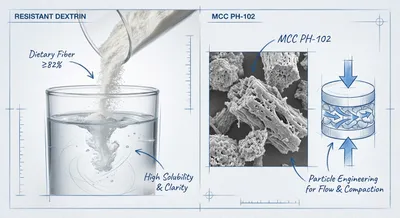
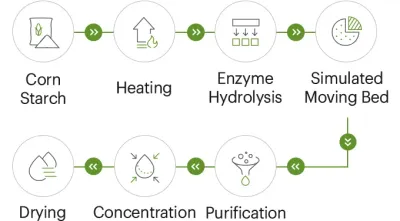
Resistant dextrin is typically positioned as a soluble dietary fiber made from starch sources such as corn or tapioca. For many formulations, the “headline spec” is fiber content, but buyers must tie that spec to a small set of supporting parameters to ensure functionality.
MCC: Grade and Particle Engineering
MCC is not simply “cellulose powder.” For pharmaceuticals and nutraceuticals, grade selection (often PH-101 vs PH-102) connects directly to flow, compaction, and content uniformity. A generic request for MCC often leads to processing issues on high-speed tablet presses.
Side-by-side Spec Checklist (RFQ-Ready)
Table A — Resistant Dextrin (Core Items)
| Spec Item | Common Buyer Request | Why It Matters in Production |
|---|---|---|
| Dietary Fiber | Fiber ≥82% or ≥90% | Drives label claim strategy and dose sizing; reduces reformulation risk. |
| Moisture | Low moisture target | Impacts flow, caking, shelf stability, and blending consistency. |
| Solubility / Clarity | Clear solubility, neutral taste | Predicts beverage clarity and sensory acceptance (crucial for drinks). |
| Micro Profile | Strict limits | Essential for avoiding batch rejection in sensitive applications like dairy or infant food. |
Table B — MCC (Core Items)
| Spec Item | Common Buyer Request | Why It Matters in Production |
|---|---|---|
| Grade | PH-101 / PH-102 | Direct compression behavior depends heavily on correct grade selection. |
| Particle Size | Linked to grade | Influences flowability and compaction; prevents weight variation. |
| Moisture | Moisture <5% | Moisture drift can change tablet hardness and disintegration time. |
| Bulk Density | Specific range | Predicts hopper flow and die filling accuracy. |
Procurement Note: A supplier can provide a "pass" COA but still fail your process if particle size distribution and moisture drift outside what your equipment tolerates.
Mapping China’s Supplier Landscape
Geography isn't a guarantee of quality, but clusters often predict what a factory is optimized to produce. When buyers search for a resistant dextrin supplier China, the market conversation frequently points to established production hubs like Shandong. Similarly, the best-known microcrystalline cellulose supplier China options often sit near mature pharma and excipient supply chains.
Resistant Dextrin: The Shandong Signal
A recurring sourcing pattern involves Shandong-based manufacturers with stable export routines. For procurement teams, this cluster signal typically implies familiarity with export documentation packs, standardized COA formats, and experience supporting application trials.
MCC: Why PH-102 Requires Specificity
For MCC—especially if your RFQ is for a MCC PH-102 supplier—buyers often prioritize suppliers with controlled environmental handling and disciplined grade segregation. Unlike basic food additives, excipients require strict adherence to particle engineering to ensure consistent tablet hardness.
The 3-Step Audit Model That Reduces Rework
The fastest sourcing projects use a structured audit because they avoid repeating the same questions across five different supplier calls. Below is a practical model applicable to both ingredients.
Step 1 — Pre-screen (Filters Before Samples)
Use pre-screening to eliminate suppliers that will create late-stage compliance or performance issues.
- Export Track Record: Can the supplier support your destination market's documentation expectations?
- Quality System Claims: ISO / HACCP / FSSC 22000 are baseline expectations for fiber ingredients.
- Capability Fit: Confirm the supplier’s ability to support stable bulk supply, not just “sample-ready” material.
Step 2 — Technical Due Diligence (Validating the COA)
At this stage, procurement should treat the Certificate of Analysis (COA) as a hypothesis. The goal is to confirm that the numbers are repeatable across batches and aligned with your internal specs.
- For Resistant Dextrin: Confirm the declared fiber ≥82% claim, test method, and solubility behavior under your specific pH conditions.
- For MCC PH-102: Confirm grade definition, particle size controls, and moisture monitoring during storage.
Step 3 — Capability Review
This is where many sourcing projects cut corners. A capability review should confirm production workshop discipline (segregation, hygiene), QC lab capability, and traceability.
Documentation Pack: What “Audit-Ready” Looks Like
Audit-ready suppliers make procurement faster because their documentation is consistent. For a resistant dextrin supplier, buyers commonly request a pack including a current COA aligned to the batch, allergen/GMO statements, and shelf-life guidance.
For an MCC supplier, the pack tends to be more excipient-focused, detailing grade definitions (PH-101 vs PH-102), test methods for particle size, and strict lot traceability. A red flag is often a "one COA fits all" document without specific lot identifiers.
Cost Reality: Beyond FOB Price
The cheapest ton is often the most expensive batch once you price in rejection, delay, and reformulation. Procurement teams often benchmark a China bulk resistant dextrin supplier and a China pharmaceutical grade MCC supplier mainly on price-per-ton. A Total Cost of Ownership (TCO) lens reveals that quality costs (inspection, rework) and failure costs (line downtime) often outweigh minor price differences.
Suppliers with tighter process controls and fewer performance surprises typically reduce total cost, even if their unit price is slightly higher.
Short Case Vignette: Defining Success
Scenario A: Beverage Brand Sourcing Fiber
A beverage team sources resistant dextrin to boost fiber while preserving taste. Their success criteria include fiber ≥82%, clear solubility, and stability under heat. The best supplier candidate is one that supports repeatable solubility behavior and provides stable packaging discipline.
Scenario B: Tablet Producer Sourcing MCC
A tablet team sources MCC PH-102 to stabilize flow. Their success criteria focus on consistent particle size distribution and minimal batch-to-batch drift. Here, the supplier is judged less by marketing claims and more by whether their process controls prevent drift that would require press re-optimization.
90-Day Action Plan
A short timeline works if each step has a clear deliverable:
- Lock Internal Specs: Finalize fiber content (e.g., ≥82%) and MCC grade (PH-102).
- Build a Shortlist: Identify 3–5 candidate suppliers for each ingredient.
- Request Harmonized COAs: Ask candidates for recent COAs from multiple lots to check consistency.
- Pilot Trials: Run a beverage solubility screen for dextrin and press trials for MCC.
- Remote Audit: Verify workflow and certifications before committing to travel.
- Finalize Dual-Sourcing: Qualify at least one backup option for resilience.
For teams building a qualified pool, consulting curated manufacturer directories and technical pages can accelerate the process. A professional example of a supplier demonstrating audit-ready documentation and production discipline is Shine Health.