
The China Sourcing Reality Check: What Resistant Dextrin and MCC Must Prove Before You Scale
[data-scope=hz-505038]article { background-color:#ffffff; padding:30px; border-radius:8px; box-shadow:0 2px 10px rgba(0,0,0,0.05); }
[data-scope=hz-505038]p .summary { font-size:0.95em; font-style:italic; color:#555555; margin-bottom:1.5em; padding-left:0; border-left:none; }
[data-scope=hz-505038]h2 , [data-scope=hz-505038]h3 , [data-scope=hz-505038]h4 , [data-scope=hz-505038]h5 , [data-scope=hz-505038]h6 { color:#333333; margin-top:1.5em; margin-bottom:1em; font-weight:600; }
[data-scope=hz-505038]h2 { font-size:1.8em; }
[data-scope=hz-505038]h3 { font-size:1.5em; }
[data-scope=hz-505038]a { color:#333333; text-decoration:none; border-bottom:1px solid #cccccc; transition:color 0.2s ease-in-out,border-bottom-color 0.2s ease-in-out; }
[data-scope=hz-505038]a :hover { color:#000000; border-bottom-color:#000000; }
[data-scope=hz-505038]img { max-width:100%; height:auto; display:block; margin:1em auto; border-radius:4px; object-fit:cover; }
[data-scope=hz-505038].centered-image { text-align:center; }
[data-scope=hz-505038].centered-image img { display:inline-block; margin:1em auto; }
[data-scope=hz-505038]table { width:100%; border-collapse:collapse; margin-bottom:1.5em; font-size:0.95em; }
[data-scope=hz-505038]th , [data-scope=hz-505038]td { border:1px solid #dddddd; padding:10px 12px; text-align:left; }
[data-scope=hz-505038]th { background-color:#f9f9f9; font-weight:600; color:#333333; }
[data-scope=hz-505038]tr :nth-child(even) { background-color:#fdfdfd; }
[data-scope=hz-505038]strong { font-weight:600; }
[data-scope=hz-505038]em { font-style:italic; }
@media (max-width:768px) { [data-scope=hz-505038]article { padding:20px; }
[data-scope=hz-505038]h2 { font-size:1.6em; }
[data-scope=hz-505038]h3 { font-size:1.3em; }
[data-scope=hz-505038].centered-image img { width:100% !important; height:auto !important; } }
@media (max-width:480px) { [data-scope=hz-505038]body { padding:10px; }
[data-scope=hz-505038]article { padding:15px; }
[data-scope=hz-505038]h2 { font-size:1.4em; }
[data-scope=hz-505038]h3 { font-size:1.2em; }
[data-scope=hz-505038]th , [data-scope=hz-505038]td { padding:8px 10px; } }
Fiber-forward product briefs are getting tougher in 2026—not because “fiber” is new, but because the expectations around **tolerance, taste neutrality, stability, and documentation** are rising simultaneously. In this environment, procurement teams increasingly treat **resistant dextrin** and **microcrystalline cellulose (MCC)** as “quiet workhorses”: ingredients that rarely appear in marketing headlines, yet determine whether a launch holds up through scale-up, shelf-life, and audits.
For buyers sourcing from China, the opportunity is significant—China remains a deep supply base for both soluble fiber and excipients—but the variance between suppliers is equally real. The most reliable outcomes come from a simple discipline: define what the ingredient must **prove** (in documents, in plant controls, and in pilot trials) before awarding volume.
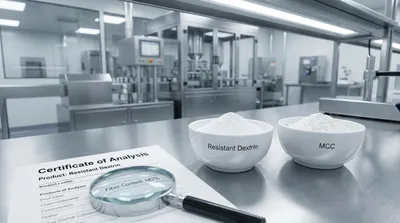
Why 2026 Specs Are Tightening (and Why Procurement Feels It First)
Two forces are converging to reshape the landscape:
- Consumer-facing nutrition trends are shifting toward “accessible nutrition,” with fiber increasingly treated as a daily essential rather than a niche functional claim.
- The GLP‑1 conversation is changing how brands formulate everyday foods—pushing more teams to build “companion” products that are easier to tolerate, lower in sugar, and more satisfying.
This combination affects sourcing in a practical way: when marketing wants fiber claims and R&D wants clean taste, procurement becomes the team that must prevent downstream failures—especially failures that only show up after a supplier switch, a moisture swing, or an unexpected microbial result.
For that reason, many RFQs now include wording such as:
- “Need a resistant dextrin supplier China can support with stable documentation.”
- “Require resistant dextrin COA fiber ≥82% QC with each lot.”
- “Request MCC pharmaceutical excipient grades PH101 PH102 for tablet robustness.”
These aren’t buzzphrases; they’re procurement controls disguised as search keywords.
Ingredient Fundamentals: What Makes Resistant Dextrin a High-Utility Soluble Fiber
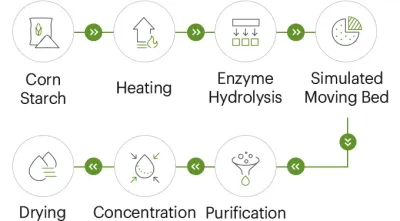
Resistant dextrin is a soluble dietary fiber produced from starch through controlled processing that creates bonds human digestive enzymes do not readily break down in the small intestine. Practically, that translates into the properties buyers care about:
- Neutral taste (helps protect flavor systems)
- Low viscosity at meaningful use levels (helps protect mouthfeel and processability)
- High solubility (important for RTD beverages and powdered nutrition)
- Formulation stability (useful across heat, shear, and a range of pH conditions depending on grade)
What “good” looks like in procurement terms
A China resistant dextrin manufacturer that can reliably support international customers typically aligns around a consistent core:
- A clearly defined raw material (commonly corn starch, often offered as NON‑GMO)
- Automated processing that reduces manual handling points
- A QC lab capable of releasing product based on repeatable test methods
- Lot-level documentation (COA + traceability) that matches the specs used in finished-product registration or internal quality standards
In the current market, the most frequently requested benchmark is fiber content ≥82% for food-grade resistant dextrin—because that number makes it easier to hit per-serving fiber targets without pushing sweetness, viscosity, or digestive tolerance too hard.
Resistant dextrin vs. “other fibers”
Buyers don’t choose resistant dextrin because it is the only fiber option. They choose it because it performs reliably when other fibers create trade-offs:
- Some fibers are excellent nutritionally but can introduce strong sweetness, flavor drift, or GI tolerance issues at higher serving sizes.
- Some fibers raise viscosity too quickly, complicating RTD processing and consumer mouthfeel.
Resistant dextrin often sits in the middle: it’s a workable soluble fiber that tends to behave predictably—so long as the supplier’s process controls keep the material consistent.
Application Mini Case Studies: Where Resistant Dextrin Earns Its Place
The best supplier evaluations start with the application. If the end product’s failure modes are known, the ingredient spec becomes sharper and the audit questions become more relevant.
1) Beverages and RTD nutrition: “high fiber” without the gel
Resistant dextrin applications beverages are growing because beverage teams want fiber without haze, excessive thickness, or instability after heat treatment.
Procurement angle: Beverage stability problems often get blamed on “formulation,” but the root cause is frequently a combination of moisture variation, particle properties, and inconsistent fiber assays between lots.
Practical buyer checks:
- Require a COA that clearly reports fiber content and protein content (protein is often a proxy for process consistency and purification effectiveness).
- Confirm storage conditions and packaging moisture control—because small moisture swings can change flowability and dispersion.
2) Bars, gummies, and confectionery
In bars and soft chews, resistant dextrin influences binding, water management, and bite. That’s why resistant dextrin applications beverages bakery bars is a common search intent: teams want one soluble fiber that can travel across multiple formats.
Procurement angle: If a supplier can’t keep particle and moisture consistency tight, bar texture can drift from “pleasant chew” to “dry crumble” or “sticky pull” across production runs.
3) Diet powders and “GLP‑1 companion” concepts
Many fiber-forward powders rely on resistant dextrin because it is commonly positioned as indigestible in the small intestine and can be formulated into low-net-carb concepts.
From a sourcing perspective, these projects raise two extra demands:
- Clear documentation around raw material origin (e.g., corn starch) and statements such as NON‑GMO when required.
- A strong change-control culture. Powder programs often live and die by “nothing changed” consistency.
China Sourcing Focus: How to Qualify a Supplier Without Guesswork
China is a strategic sourcing region for soluble fiber, but procurement success depends on treating qualification as a sequence, not a single event.
Step 1: Decide what “pass” looks like on paper
For many buyers, the minimum starting point is a lot-level COA that can be matched to internal requirements. Below is a practical, procurement-oriented spec target format used when shortlisting a resistant dextrin supplier China can support across repeated orders.
| Item | Why it matters | Typical buyer target (example) |
|---|---|---|
| Fiber content | Cost-per-claim and serving-size feasibility | ≥82% |
| Appearance | Predictable visuals in blends and drinks | White to light yellow |
| Protein | Proxy for purification/process consistency | ≤6.0% |
| Storage | Helps prevent caking and COA drift | Store in a cool place |
When a supplier’s documentation is inconsistent, the sourcing cost isn’t just “more emails.” It’s the risk of reformulation, relabeling, or a delayed launch.
Step 2: Validate raw material traceability
A capable China resistant dextrin manufacturer should be able to explain, without hesitation:
- The starch source (commonly corn starch) and traceability approach.
- Segregation and allergen management.
- Cleaning procedures and how cross-contact risk is prevented.
In many well-run operations, buyers will also see language such as automated central-control operation from feeding to filling. Those details matter because they reduce variability—the quiet enemy of high-fiber product launches.
Step 3: Run a pilot that proves the risk points
A high-quality pilot plan is one that tries to break the formula on purpose: test dispersion at low and high shear, stress acidity and heat where relevant, and validate sensory neutrality at target serving size. The purpose is simple: ensure the ingredient behaves consistently enough that procurement can dual-source without rework.
Where MCC Fits: Why Buyers Pair Microcrystalline Cellulose With Fiber Projects
Even though resistant dextrin is a food fiber story, many global procurement teams are simultaneously sourcing microcrystalline cellulose (MCC)—because MCC supports stability and performance across pharmaceutical excipients and some food applications.
For buyers, MCC becomes relevant in three common scenarios:
- Tablets and solid-dose formats: MCC is widely used as a filler/binder to support compressibility.
- Powder blends and sachets: MCC can help with flow, handling, and blend uniformity.
- Cross-category supplier consolidation: Teams prefer fewer, more reliable vendor relationships when documentation and audits are heavy.

MCC grades: what PH101 vs. PH102 usually means for purchasing
Buyers frequently request MCC pharmaceutical excipient grades PH101 PH102 because the grade influences particle size, flow, and compression performance. A practical approach is to define the dose form and process (direct compression vs. wet granulation), match the grade to flow/compressibility needs, and require consistent COA fields.
This is also where “Recommended Chinese Microcrystalline Cellulose Supplier” search intent becomes meaningful: buyers are looking for suppliers that can support pharma-style documentation discipline.
What “Recommended” Really Means in 2026: A Benchmark Profile
Search phrases like Recommended Chinese Resistant Dextrin Manufacturer exist because buyers have learned a hard truth: “competitive price” is meaningless if the ingredient can’t survive validation. A supplier that merits “recommended” status in a procurement shortlist typically demonstrates:
- Stable raw material strategy (e.g., NON‑GMO corn starch option with clear sourcing narrative)
- Modern production discipline (automation and central-control systems)
- Credible QC (lot release processes, retains, and response capability)
- Documentation readiness (COA completeness, traceability, and change-control)
- Application support that is practical
This is why some buyers use established, audit-ready producers as benchmarks when comparing quotes—especially suppliers that openly publish technical product pages and process visuals.
Packaging and Logistics: The Overlooked Control Point
Even the right resistant dextrin can disappoint if packaging fails moisture management. Buyers should verify sealed, moisture-protective packaging, clear batch labeling with traceability codes, and storage guidance that reflects the ingredient’s flowability needs.
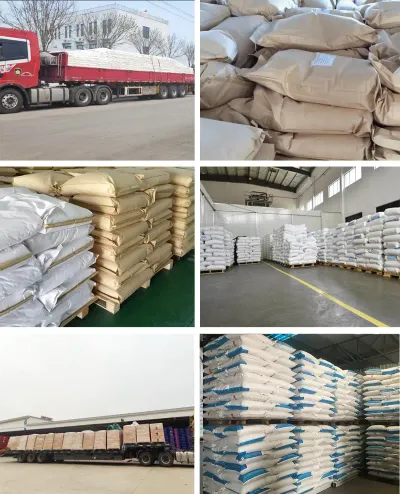
Packaging is where “factory quality” meets real-world freight conditions. Treat it as part of the spec, not an afterthought.
Turning Fiber Hype Into Supply That Holds Up
In 2026, the most successful fiber-forward launches won’t come from chasing the trend headline. They will come from teams that treat resistant dextrin as a supply chain discipline: a soluble fiber that must be validated in COAs, protected by process controls, and proven in pilots. Similarly, MCC sourcing success is less about finding a new vendor and more about qualifying a documentation-ready partner.
For procurement teams building a vetted China shortlist, it is useful to benchmark against established fiber and excipient specialists that openly publish product documentation frameworks and manufacturing visuals. A practical starting point for that kind of benchmark review is: