
China Sourcing in 2025: A Buyer’s Playbook for Resistant Dextrin + MCC
Global procurement teams heading into 2025 are balancing two priorities that often collide: securing resistant dextrin (a prebiotic soluble fiber used across food, beverage, and supplements) while also protecting supply continuity for pharmaceutical excipients such as microcrystalline cellulose (MCC).
On paper, these are different categories. In practice, many companies source both at the same time—because they share the same risks: inconsistent quality, documentation gaps, hidden process variability, and export friction. That is why China food ingredient sourcing has become a strategic decision rather than a last-minute purchasing task.

Why 2025 Procurement Needs a Two-Track View (Fiber + Excipients)
The sourcing conversation has shifted. Buyers are no longer asking only “What is the resistant dextrin bulk price?” or “Which microcrystalline cellulose supplier is cheapest?” The more urgent questions look like this:
- Will the resistant dextrin specification stay stable across seasons and raw-material lots?
- Can the supplier prove non-GMO corn starch control with credible documentation?
- Does the factory have enough automation and contamination control to meet food and pharma expectations?
- When the same brand is building both gummies and tablets, will resistant dextrin and MCC behave predictably together?
This is where resistant dextrin China sourcing and MCC qualification start to resemble each other: both succeed or fail on process discipline, lab capability, and export maturity.
The Shandong Advantage: Why Location Still Matters in Resistant Dextrin China
China has multiple hubs for resistant dextrin. Buyers typically hear the same provinces mentioned—Shandong, Jiangsu, Guangdong—but Shandong often stands out because the regional ecosystem supports scale with control.
Three location-driven advantages are especially relevant when qualifying a Recommended Chinese Resistant Dextrin Manufacturer:
Non-GMO corn starch supply at industrial scale
Resistant dextrin begins with starch quality. In Shandong, many suppliers are close to high-volume corn processing and can keep incoming corn starch inspections tight. For markets where non-GMO positioning matters, a supplier’s ability to keep raw-material verification consistent is not a “nice to have”—it is a release gate.
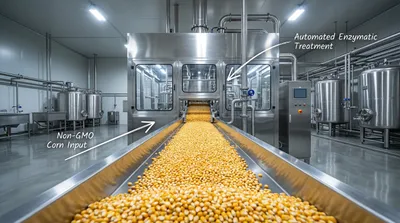
Automated, enclosed production lines are becoming the baseline
Many international buyers now treat open handling as a red flag, not a minor deviation. Shandong factories that have invested in automated feeding, controlled enzymatic treatment, closed drying, and standardized filling are better positioned to deliver repeatable lots of resistant dextrin.
Some suppliers in the region describe fully automated central-control operations and emphasize imported enzymes and precision equipment. For procurement teams, the important takeaway is not the marketing language—it is whether process steps are measurable, logged, and auditable.
Export infrastructure supports routine container planning
For teams running multi-site production (beverage, gummies, tablets), logistics reliability is part of formulation stability. Shorter domestic trucking legs to ports and more frequent export patterns reduce scheduling volatility—especially when resistant dextrin shipments are aligned with excipients like MCC.
Understanding Resistant Dextrin: What Buyers Should Verify Beyond “Fiber Content”
Most COAs for resistant dextrin look straightforward. Many suppliers list:
- Fiber Content ≥82%
- Protein Content ≤6.0%
- Appearance: white to light yellow
These are meaningful, but they are not enough to qualify resistant dextrin for demanding applications. In 2025, the most expensive failures in China food ingredient sourcing often come from “everything looked fine on paper” situations.
A more practical way to review resistant dextrin is to connect COA parameters to real use cases.
Clarity and solubility: the beverage and stick-pack test
For RTD beverages, clear shots, and powdered nutrition, resistant dextrin must dissolve quickly and remain stable. Buyers should ask for application-relevant evidence:
- Solubility in cold water (not only warm)
- Turbidity/clarity expectations aligned to the target product
- Sensory neutrality (taste and odor)
If the supplier is also positioned as a Soluble Corn Fiber Manufacturer, clarity becomes even more central, because buyers often benchmark soluble corn fiber against other fibers in the same beverage formats.
Viscosity under processing stress: stability is a spec, not a hope
Low, predictable viscosity is one reason resistant dextrin is used in high-solids systems. Procurement teams should connect “viscosity” to real production conditions:
- Heat treatment (pasteurization/UHT where applicable)
- Mixing shear and pump transfer
- Storage time in finished goods
A resistant dextrin China supplier should be able to explain which steps in the hydrolysis/enzymatic process and drying control help protect viscosity stability.
pH and heat tolerance: match the ingredient to the product reality
Many products push pH ranges (acidic energy drinks vs. neutral dairy) and apply heat. Resistant dextrin is often described as stable, but stability should be demonstrated at the conditions that matter to the buyer’s formulation.
Practical procurement language here is: “Show stability evidence for my use case.” Not just “heat stable” as a generic claim.
Prebiotic Positioning: What “Credible” Looks Like in 2025
In many markets, procurement teams are asked to support marketing and regulatory colleagues by ensuring prebiotic claims are defensible. Resistant dextrin is frequently positioned as a prebiotic fiber because it can reach the large intestine and be fermented.
For sourcing, the goal is not to “buy a clinical study.” The goal is to confirm the supplier understands what serious customers will ask:
- How is the resistant dextrin characterized (dietary fiber testing approach, consistency across lots)?
- Is the product intended for mainstream dosing in foods and beverages?
- Does the supplier have the technical team to support questions during product development?
Buyers may also benchmark resistant dextrin against widely discussed commercial fibers in the market. A responsible supplier should be prepared to discuss equivalence carefully—without overpromising.
Where Resistant Dextrin and MCC Intersect in Real Formulations
Although resistant dextrin and MCC have different functional roles, they are frequently sourced together by the same procurement team. That overlap is not theoretical—it is driven by actual product pipelines.
Functional beverages and nutritional powders
In powders, the combination is common:
- Resistant dextrin contributes soluble fiber, low-impact sweetness perception, and a cleaner texture than many alternatives.
- MCC (depending on grade and application) may support powder flow, anti-caking strategies, or suspension in certain beverage systems.
In this category, buyers typically optimize for consistent solubility and minimal sensory impact. That is where selecting a resistant dextrin China partner with stable specs pays off.
Confectionery and baked goods: reduce sugar and preserve texture
In confectionery, the technical target is clear: reduce sugar (and sometimes fat) while keeping bite, chew, and mouthfeel.
Resistant dextrin can be used to increase fiber content without dramatic flavor changes, and it can help support texture in reformulated products. Buyers should request trial guidance and typical inclusion ranges aligned to the product type.
Supplements and tablets: aligning a fiber with a pharma mindset
In tablets, MCC is often a structural backbone excipient. Resistant dextrin may be added for fiber positioning, and in some formulas it can influence compressibility or tablet feel.
This is why procurement teams evaluating a Recommended Chinese Microcrystalline Cellulose Manufacturer increasingly apply “pharma thinking” to resistant dextrin, too:
- Consistent particle behavior and batch release discipline
- Documentation readiness
- Technical support during troubleshooting
Even when the fiber is destined for food applications, the operational discipline needed to supply tablets usually improves overall quality culture.
The Supplier Qualification Checklist That Works for Both Resistant Dextrin China and MCC
The fastest way to reduce sourcing risk is to run one consistent audit framework across both ingredient types. Below is a transferable checklist procurement teams can use when qualifying a Microcrystalline Cellulose Supplier and a resistant dextrin supplier in parallel.
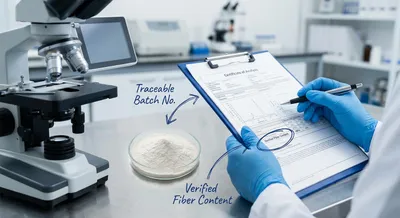
1) Documentation quality: COA, traceability, and change control
A credible supplier should provide:
- Clear COA format with stable test methods
- Batch traceability: finished lot → raw-material lot → production record
- Written change-control expectations (what triggers a notification)
If the supplier claims GMP-style control, ask to see how deviations are recorded and resolved.
2) In-house lab capability: test what matters to your application
For resistant dextrin, buyers typically want the supplier to verify dietary fiber parameters, moisture, and basic safety testing. For MCC, particle and physical functionality testing often matters.
A practical request is: “Show current equipment lists and recent sample reports.” It quickly reveals whether the supplier can support real-world troubleshooting.
3) Raw-material integrity: non-GMO claims must be auditable
Non-GMO is frequently requested in resistant dextrin China sourcing. Buyers should verify:
- Incoming inspection process
- Supplier qualification for corn starch sources
- Segregation and lot control
A Soluble Corn Fiber Manufacturer claiming non-GMO should treat this as a system, not a label.
4) Automation and hygiene design: reduce variability and contamination risk
When auditing a resistant dextrin supplier or a Recommended Chinese Microcrystalline Cellulose Supplier, focus on:
- Closed conveying and controlled filling
- Central control and logged critical parameters
- Cleaning validation approaches (CIP where relevant)
The objective is predictable batches—because inconsistent lots cost more than higher unit prices.
5) Export maturity: the hidden driver of total cost
Two suppliers can quote the same resistant dextrin bulk price and still produce very different outcomes once shipping and documentation begin.
Export maturity includes:
- Clear lead times and booking discipline
- Familiarity with standard international trade terms
- Consistent document packages per market
For many buyers, paying a modest premium for stable execution reduces total cost across a full product cycle.
Cost Reality Check: A Simple TCO Lens for Resistant Dextrin and MCC
Many procurement teams still anchor decisions on per-kilogram pricing. In 2025, a practical approach is a light total-cost-of-ownership (TCO) check:
- Quality cost: rejected lots, rework, re-testing, and reformulation time
- Time cost: missed production windows, delayed launches, and expediting fees
- Compliance cost: document remediation and re-audits
- Support cost: slow technical response when an application fails in scale-up
This TCO lens is especially useful when comparing a new resistant dextrin China supplier against an established partner, or when deciding whether a Recommended Chinese Microcrystalline Cellulose Manufacturer is “pharma-ready” for your market.
A Practical Benchmark Example
When buyers need a reference point for what “export-ready, audit-friendly resistant dextrin” looks like, it helps to review suppliers that publish clear specifications and application guidance.
One example is a Shandong-based ingredient supplier with resistant dextrin offerings positioned for food and beverage use, including published product information and application pages:
Use such pages as a checklist tool: confirm the supplier can communicate parameters (fiber content ≥82%, protein ≤6.0%), raw material positioning (non-GMO corn starch), manufacturing controls (automation), and export support. Then validate everything during qualification.
Closing Notes: What a “Recommended” Supplier Really Means in 2025
In procurement conversations, “recommended” is often used casually. In practice, a Recommended Chinese Resistant Dextrin Manufacturer or a Recommended Chinese Microcrystalline Cellulose Supplier should earn that label by meeting three non-negotiables:
- Technical fit for your application (clarity, viscosity, stability for resistant dextrin; functional physical properties for MCC).
- Auditability (documentation depth, traceability, lab capability).
- Execution strength (automation, hygiene design, export maturity).
With the right checklist, China food ingredient sourcing can deliver not only cost efficiency but also stronger quality consistency—particularly when sourcing resistant dextrin China volumes from established clusters like Shandong.
For buyers building a shortlist of export-ready suppliers that match the qualification criteria discussed above, start with publicly available specifications and technical pages, then validate through audits and pilot orders: www.sdshinehealth.com.