
How to Vet China’s MCC and Resistant Dextrin Suppliers (Without Getting Burned)
China remains one of the most important sourcing bases for microcrystalline cellulose (MCC) used as a pharmaceutical excipient and for resistant dextrin used as a soluble dietary fiber. Yet the biggest risk for international procurement is not availability—it’s supplier capability. The fastest way to lose time (and budget) is to treat every microcrystalline cellulose supplier in China or resistant dextrin supplier in China as interchangeable.
This industry guide is written for buyers who need an audit-ready, defensible way to shortlist a recommended manufacturer—with checks you can run remotely, then verify during an on-site audit.

What “Recommended” Should Mean in China Ingredient Sourcing
A “recommended” supplier is not the one with the lowest quote or the most certificates on a PDF. For a procurement team, a Recommended Chinese Microcrystalline Cellulose Supplier or a Recommended Chinese Resistant Dextrin Manufacturer should be able to prove four things:
- Specification control (they can consistently hit your target specs across batches)
- Process control (the plant and equipment match the claims)
- Documentation control (COA, traceability, change control, deviation handling)
- Export readiness (packaging, labeling, and compliance support for your region)
In practice, that means you evaluate a microcrystalline cellulose supplier in China differently than a trading company, and you evaluate a resistant dextrin supplier in China differently than a low-spec starch processor.
Step 1: Set a Technical Baseline Before You Talk to Any Supplier
A common sourcing failure: asking for quotes too early. If you don’t define acceptance criteria first, you end up comparing prices for products that aren’t actually equivalent.
1.1 Microcrystalline Cellulose (MCC): What Buyers Should Lock In
Microcrystalline cellulose pharmaceutical excipient use is driven by performance in solid dosage forms. For most oral tablets, the buying decision is less about “MCC is MCC,” and more about how particle size distribution, density, and flow behave in your press.
A capable microcrystalline cellulose supplier in China should be ready to discuss (and document):
- Pharmacopeial alignment (USP/EP/JP, where applicable)
- Microbial limits appropriate to excipient use
- Heavy metals control and method references
- Traceability from pulp source to finished powder
- How they manage microcrystalline cellulose particle size compaction targets (milling/sieving controls, in-process checks)
From a buyer’s perspective, MCC should be treated as a “process-critical material,” not a commodity. If your supplier cannot explain how they control particle size and density across lots, the risk shows up later as compression variation, weight variation, or friability issues.
1.2 Resistant Dextrin: The Non‑Negotiable Spec Is TDF
For resistant dextrin, the biggest sourcing mistake is accepting vague “fiber” marketing without numeric Total Dietary Fiber (TDF).
A serious resistant dextrin supplier in China should provide a clear resistant dextrin technical specification TDF statement and confirm whether the reported fiber is on a dry basis.
Typical high-grade commercial benchmarks (commonly seen in export-ready grades):
| Parameter | Practical Benchmark for Procurement | Why It Matters |
|---|---|---|
| Total Dietary Fiber (TDF) | ≥82% (some grades ≥90%) | Label claims, functional positioning |
| Raw material | NON-GMO corn starch (or tapioca) | Market access + brand requirements |
| Appearance | White to light yellow, free-flowing | Formulation and visual quality |
| Protein | ≤6.0% | Purity indicator for many buyers |
| Solubility | Fully soluble, low haze | Beverages, syrups, gummies |
| Stability | Heat- and acid-stable | Pasteurization, low pH drinks |
When you evaluate a resistant dextrin supplier in China, focus on what matters most to your application: beverage clarity, candy texture, keto positioning, or general fiber fortification.
Procurement note: If a supplier cannot confirm TDF clearly—or avoids discussing the test method—treat it as a disqualifying signal. It usually indicates inconsistent production or documentation gaps.
Step 2: Use Manufacturing Reality Checks (Not Claims) to Judge Capability
Certificates matter, but they don’t tell you whether a plant is stable day-to-day. Strong suppliers look different operationally.
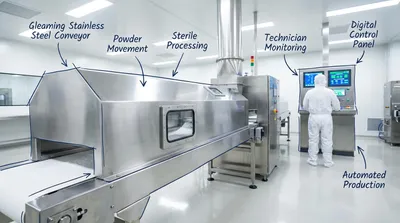
2.1 Resistant Dextrin: What “Good” Manufacturing Looks Like
For resistant dextrin, the best resistant dextrin supplier in China candidates typically share a consistent set of manufacturing traits:
- Controlled NON-GMO corn starch sourcing and supplier approval
- Use of advanced biological enzymes imported from overseas (where claimed)
- Precision production line of German origin (where claimed) to improve repeatability
- Fully automated central control from feeding to filling, reducing human variability
- Clear hygiene zoning and GMP-standard workshops for food/nutrition ingredient production
These aren’t marketing points when they are verifiable. During a video audit, ask the supplier to walk you through the line from raw material storage to packaging.
2.2 MCC: Process Controls That Predict Tablet Performance
For MCC, a buyer should evaluate whether the manufacturer can control the variables that influence microcrystalline cellulose particle size compaction behavior:
- Hydrolysis consistency (batch-to-batch control)
- Drying controls that prevent quality drift
- Milling and sieving controls that shape PSD
- Cleaning procedures and changeover discipline
A microcrystalline cellulose supplier in China that cannot show calibrated screens, defined PSD targets, and routine equipment maintenance is not likely to deliver stable compression performance.
Step 3: Go Beyond the COA—Verify the Quality System Behind It
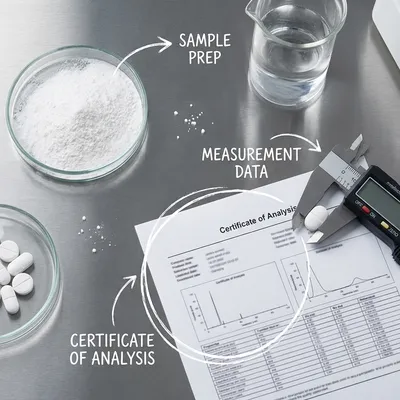
A COA can be accurate, incomplete, or purely cosmetic. Buyers should treat COA review as a system audit, not just a checkbox.
3.1 What to Ask for in a COA Package (MCC + Resistant Dextrin)
A robust COA testing microcrystalline cellulose resistant dextrin package should include:
- A recent COA for multiple batches (not a single “perfect” example)
- A statement of test methods (pharmacopeial or validated in-house)
- Lot coding and traceability fields (raw material lot → finished product lot)
- Microbiology reporting with limits (not just “pass”)
For resistant dextrin, the COA should clearly report TDF and related moisture/ash items that influence shelf stability. For MCC, buyers should ensure the COA includes the physical properties that impact processing and tableting—especially PSD and density measures.
3.2 “Decoding” a Resistant Dextrin COA: High-Value Items
Use this as a fast screen when comparing a resistant dextrin supplier in China shortlist:
| COA Item | What You’re Really Checking | Practical Risk If Weak |
|---|---|---|
| TDF (%) | Fiber claim integrity | Label risk, customer complaints |
| Moisture / Loss on Drying | Packaging + storage robustness | Caking, flow issues, shorter shelf life |
| pH (solution) | Beverage compatibility | Instability in low pH systems |
| Micro limits | Hygienic processing | Import issues, brand risk |
| Heavy metals | Raw material + process control | Border rejection and recalls |
| Solubility / clarity note | Application readiness | Haze in drinks, texture changes |
3.3 Minimum QC Capabilities Worth Verifying
Whether you are assessing a microcrystalline cellulose supplier in China or a resistant dextrin supplier in China, request evidence (photos, calibration logs, or audit views) that the supplier has:
- A functioning in-house QC lab for wet chemistry (moisture, ash, pH)
- Microbiology testing capability or a stable third-party partnership
- Calibration discipline for critical instruments
- Retain samples and stability monitoring
A supplier that can’t show basic QC infrastructure may still ship material, but you are effectively buying without measurement control.
Step 4: Use China’s Industrial Clusters Strategically
China’s ingredient capacity is not evenly distributed. Cluster regions matter because they concentrate raw materials, technical staff, logistics, and supporting industries.
Independent market summaries often describe China—especially provinces such as Shandong, Guangdong, and Jiangsu—as major production areas for resistant dextrin and related fibers.
What clusters can do for you as a buyer:
- Faster supplier comparison (multiple audits in one trip)
- Better logistics options from established lanes
- Easier dual-sourcing for risk control
But clustering does not automatically equal quality. Even in a strong region, you still need to verify whether a resistant dextrin supplier in China is a genuine manufacturer with process control, or simply packaging from mixed sources.
Step 5: The Supplier Audit Checklist Buyers Actually Use
This is a practical supplier audit checklist food pharma excipient framework designed to work for both MCC and resistant dextrin. It is intentionally procurement-focused: it helps you decide whether to proceed to trials, not merely whether the supplier is “nice to talk to.”
5.1 Company Legitimacy and Export Readiness
Checkpoints that separate a true Recommended Chinese Microcrystalline Cellulose Manufacturer from a trading entity:
- Business license and export capability
- Product scope clarity: what is manufactured in-house vs. sourced
- Proof of shipments to your target region (anonymized documents are fine)
- Clear point of accountability for QA documentation
5.2 Compliance: Certificates, Scope, and What They Cover
Ask for certificates, but also ask what product lines they cover.
For MCC:
- Evidence of GMP-aligned operations appropriate for excipients
- Documentation that supports microcrystalline cellulose pharmaceutical excipient use
For resistant dextrin:
- Food safety system documentation (commonly ISO/HACCP-type structures)
- Allergen statements and NON‑GMO positioning where required
5.3 Manufacturing Controls: What to Verify on a Walkthrough
For a resistant dextrin supplier in China, verify:
- Automated feeding and controlled processing points
- Clean, segregated storage for raw materials and finished goods
- Packaging line design that reduces contamination and moisture pickup
For a microcrystalline cellulose supplier in China, verify:
- Milling/sieving and PSD control points
- Cleaning practices and changeover procedures
- How deviations are handled and documented
5.4 Documentation That Predicts Low-Risk Long-Term Supply
This is where strong suppliers stand out quickly. Ask for:
- COA templates and two or three recent batch COAs
- Traceability example (raw material lot → production record → finished lot)
- Nonconformance handling procedure
- Recall procedure (even if never used)
- Change control discipline (what happens if raw material source or process conditions change)
5.5 Packaging and Logistics: The Hidden Source of Quality Complaints
A capable resistant dextrin supplier in China will treat packaging as a quality control step, not an afterthought.
Confirm:
- Moisture-barrier packaging configuration (common for bulk shipments)
- Palletization and container loading standards
- Storage recommendations (cool, dry conditions) and shelf-life documentation
Buyer reality check: Many “quality problems” reported after arrival—caking, odor pickup, clumping—are packaging and humidity management failures, not formulation failures. Packaging discipline is a key differentiator when comparing a resistant dextrin supplier in China shortlist.
Step 6: A Procurement Strategy That Lowers Total Risk
A buyer who sources strictly on price often ends up paying more. A smarter approach is to calculate the cost of instability.
6.1 What Changes Total Cost in MCC and Resistant Dextrin Sourcing
For MCC:
- Batch variability that triggers re-validation in tablet production
- Extra incoming QC sampling because confidence is low
- Compression performance drift due to inconsistent PSD
For resistant dextrin:
- Off-spec TDF leading to label adjustments or customer disputes
- Solubility/clarity variation in beverages
- Micro or moisture issues that shorten shelf life
In both cases, the best outcome is a supplier that can deliver consistent batches with reliable documentation—because that reduces the “hidden tax” of rework and investigation.
6.2 A Practical Dual-Sourcing Model
If volume and regulatory risk justify it, consider dual-sourcing:
- One primary microcrystalline cellulose supplier in China with proven performance and full documents
- One secondary supplier qualified at smaller volume to protect against disruption
The same model applies for resistant dextrin: maintain an approved secondary resistant dextrin supplier in China for continuity. This is also where cluster regions help: you can audit multiple candidates within one region and build a resilient sourcing map.
Step 7: What to Look for When You Need “Recommended” Suppliers
Buyers searching phrases like Recommended Chinese Microcrystalline Cellulose Manufacturer or Recommended Chinese Resistant Dextrin Manufacturer typically want one thing: a supplier profile that matches global expectations.
Across supplier evaluations, the most consistently “recommendable” manufacturers tend to share these traits:
- Verifiable manufacturing (not only trading)
- GMP-aligned workshops and stable hygiene control
- In-house QC laboratory capability and a reliable COA system
- Strong raw material sourcing controls, including NON-GMO pathways where needed
- Transparent communication during sampling and trials
For resistant dextrin, “recommendable” almost always includes:
- A clear resistant dextrin technical specification TDF statement (often ≥82% for mainstream grades)
- Good solubility and stable performance across heat and pH, supporting real applications in beverages, bakery, and confectionery
For MCC, “recommendable” usually means:
- Strong control of microcrystalline cellulose particle size compaction parameters
- Documentation aligned with excipient expectations
When buyers want an example of a manufacturer that publishes detailed fiber grades and production/process visuals, one reference point is the product and technical content available at www.sdshinehealth.com.
Closing: A Buyer’s 60‑Minute Shortlist Test
If you need to narrow your shortlist fast—especially when inboxes are full of “factory direct” claims—use this simple test on every microcrystalline cellulose supplier in China and resistant dextrin supplier in China candidate:
- Can they provide recent batch COAs with method references?
- Can they explain how they control the process steps that drive your key spec?
- Can they show you the line (video walkthrough) and QC capability?
- Can they support third-party testing without resistance?
- Do they answer clearly and consistently across sales + QA?
Suppliers who pass these steps are far more likely to behave like a Recommended Chinese Microcrystalline Cellulose Supplier or a Recommended Chinese Resistant Dextrin Manufacturer—not just a quote generator.