
Fast-Track Beverage Formulation: RD + MCC for Stability and Mouthfeel
Functional beverages are no longer a niche: buyers now expect low-calorie nutrition, fiber enrichment, and a consistently smooth, “finished” drinking experience—whether the product is ready-to-drink (RTD) or a powder that must rehydrate cleanly.
For R&D and procurement teams, that translates into one recurring requirement: choose functional beverage ingredients that solve both stability and sensory quality without over-complicating processing or the label.
A proven approach is to pair resistant dextrin (RD)—a process-tolerant soluble fiber—with microcrystalline cellulose (MCC), widely used as a structuring stabilizer. Together, they support a practical resistant dextrin beverage formulation strategy that targets: suspension, reduced sedimentation, improved texture, and fiber claims.

1) What RD and MCC Actually Do in Beverages
1.1 Resistant dextrin: soluble fiber that stays out of the way
In beverage systems, resistant dextrin is valued because it contributes nutrition and subtle body while remaining highly soluble and typically low in viscosity—a combination that helps formulators avoid the “gummy” texture that some hydrocolloids create.
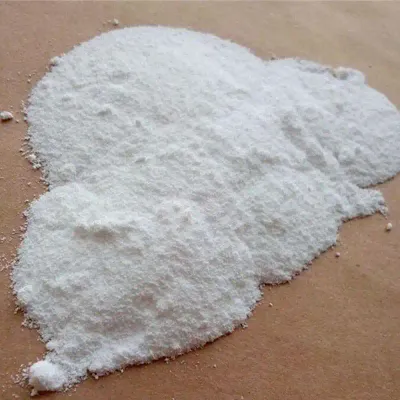
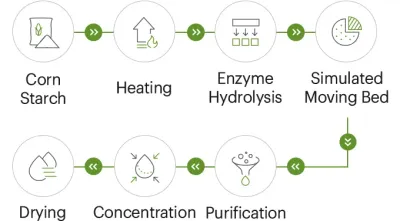
Shandong Shine Health’s resistant dextrin (made from non-GMO corn starch) is positioned as a dietary fiber ingredient suitable for food and diet powders, with typical specifications including:
- Appearance: white to light yellow powder
- Dietary fiber content ≥82%
- Protein: ≤6.0%
- Neutral taste and a near-colorless solution
- Good process tolerance for common beverage conditions (heat/acid stability is frequently expected in this fiber category)
From a functional beverage ingredients perspective, RD is frequently used for:
- Fiber-enriched drink formulation (supporting “source of fiber” or higher-fiber positioning, depending on local rules)
- Resistant dextrin mouthfeel enhancement (light body without heavy thickness)
- Resistant dextrin powder stability improvement in dry blends (better handling and mixing behavior)
- A spray-dried resistant dextrin carrier role for flavors or nutrients in some powdered systems
1.2 MCC: suspension and texture without turning drinks into gels
Microcrystalline cellulose is an insoluble cellulose fraction used across foods and nutraceuticals. In beverages, it’s best understood as a “structure builder” that helps keep particles suspended and improves perceived creaminess.
Depending on grade and system design, MCC can act as:
- A microcrystalline cellulose beverage stabilizer to reduce sedimentation
- A texture builder (often described as a fat-mimetic effect in low-sugar or reduced-fat profiles)
- A contributor to MCC anti-caking powder flow in instant mixes (especially in dry formats)
Beverage developers often reference dispersible or co-processed systems (commonly MCC combined with CMC) because those hydrate and disperse more reliably. In procurement language, this is where the co-processed MCC CMC suspension aid category becomes important: it can deliver better suspension at lower use levels than a basic cellulose alone.
2) Why RD + MCC Works: A Clear Division of Labor
When the two are combined, the formulation benefits are not redundant—they’re complementary:
- RD (soluble) contributes fiber and a clean, lightly rounded body—supporting low-calorie beverage texture enhancer targets without “gumming up” the drink.
- MCC (insoluble structuring) helps keep heavier phases suspended and improves creaminess—supporting “shake-like” sensory cues even when sugar and fat are reduced.
This is why many teams frame the pairing as mouthfeel optimization RD MCC: RD lifts the baseline texture and nutritional profile, while MCC handles the physical stability risks.
3) Fast Application Playbook (RTD + Powder-to-Drink)
The goal here is speed: a buyer or formulator should be able to translate ingredient capability into trial design. The ranges below are starting points, not universal rules.
3.1 High-fiber, low-calorie protein shakes
Common problem: protein sedimentation, phase separation, chalky mouthfeel.
Practical RD + MCC pattern:
-
RD: ~1–3% w/w
- Adds fiber without heavy sweetness
- Supports resistant dextrin mouthfeel (smoother body than water-thin systems)
- Helps maintain clean flavor delivery
-
MCC or co-processed MCC–CMC: ~0.2–0.6% w/w
- Acts as a microcrystalline cellulose beverage stabilizer
- Builds a suspension network that reduces protein settling
- Supports creamy, shake-like texture in reduced-fat profiles
In many projects, the real win is operational: the RD + MCC approach can reduce reliance on multiple high-viscosity gums and still achieve stable texture.
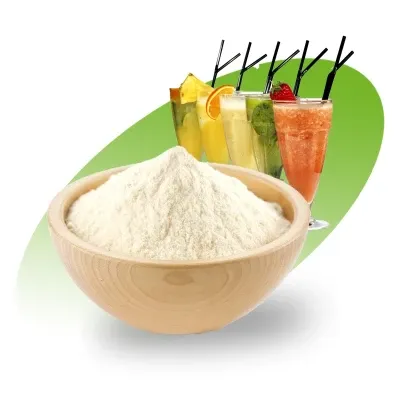
3.2 Instant powdered drinks with clean rehydration
Common problem: clumping, poor wetting, sediment “ring,” uneven distribution of actives.
Practical RD + MCC pattern:
-
RD as part of the base blend or as a spray-dried resistant dextrin carrier
- Supports instant powdered drink rehydration through high solubility
- Contributes resistant dextrin powder stability in storage (helping flow and reducing stickiness in many dry systems)
-
MCC (dispersible grade):
- Serves as an MCC instant drink stabilizer
- Improves suspension after spoon stirring
- Supports MCC anti-caking powder flow when the overall dry mix is optimized
If the powder contains cocoa, minerals, plant extracts, or protein fines, the MCC system often becomes the deciding factor in whether the beverage looks “professional” after mixing.
3.3 Fiber-enriched teas, coffees, and acidic RTD beverages
Acidic RTD formats (often around pH 3–4) are unforgiving: ingredients must tolerate heat treatment and still look stable on shelf.
In these systems:
- RD is typically chosen because it is easy to dissolve, remains neutral in taste, and supports fiber-enriched drink formulation.
- MCC is typically used in low dosages to manage haze/body and keep fine solids suspended.
The pairing is especially relevant when brands want a cleaner label and a steady appearance over the full shelf-life window.
4) Processing Notes Buyers Should Ask About (Before Sending the PO)
Even a strong functional beverage ingredients strategy can fail because of dispersion behavior. For procurement teams, it helps to ask suppliers for handling guidance that matches the product format.
4.1 Typical starting ranges (quick reference)
-
Resistant dextrin beverage formulation: ~0.5–3.0% w/w
- 0.5–1.5%: lighter texture + modest fiber contribution
- 2.0–3.0%: stronger fiber positioning and more body
-
MCC / co-processed MCC–CMC: ~0.2–1.0% w/w
- Lower end: fine-particle suspension with minimal viscosity
- Higher end: stronger creamy texture and shake-like body
4.2 Hydration and order of addition (what to confirm)
For RTD systems, ask whether the MCC system requires:
- pre-dispersion under high shear,
- a defined hydration window, and
- a specific sequence relative to proteins, minerals, or plant extracts.
For powder-to-drink systems, confirm whether the supplier can recommend blending order that improves wetting and reduces dusting—this often affects consumer-perceived quality more than small formula tweaks.
5) Supplier Evaluation: A Checklist for RD and MCC Sourcing in China
This section is designed for procurement teams screening a Chinese resistant dextrin manufacturer and a China microcrystalline cellulose supplier. The goal is to reduce qualification risk, not to chase the lowest unit price.
5.1 Documentation and site-level readiness
Request evidence for:
- Food-grade quality management (commonly ISO, plus process food safety systems such as HACCP)
- GMP-style controls where applicable (especially when the ingredient will be used in nutraceutical positioning)
- Traceability for raw materials (for RD, confirm non-GMO corn starch origin where required)
Shine Health publicly describes non-GMO corn starch sourcing, imported biological enzymes, and a precision production setup—attributes many buyers now treat as baseline for export-grade functional beverage ingredients.
5.2 COA parameters that actually predict beverage performance
For resistant dextrin, beverage buyers commonly request:
- Dietary fiber content (e.g., ≥82%)
- Moisture / water activity
- Protein and ash
- Microbiological limits
- Particle size distribution (helps predict dissolution speed and sensory perception)
For MCC systems (especially when the target is co-processed MCC CMC suspension aid performance), request:
- Dispersibility in water and recommended shear conditions
- Bulk density (useful for powder handling and dosing)
- Application guidance for RTD vs instant powders

5.3 Capability signals: the “soft” factors that prevent reformulation later
When qualifying a Recommended Chinese Resistant Dextrin Manufacturer, or a Recommended Chinese Microcrystalline Cellulose Supplier, look for:
- Ability to support pilot trials (even a short application note helps prevent weeks of iteration)
- Consistency of supply and packaging options (e.g., standard industrial bags; stable lead times)
- Technical responsiveness (especially for mouthfeel optimization RD MCC work)
- Export experience and documentation readiness
A practical procurement approach is to approve two suppliers per ingredient class when possible—one primary and one backup—so that new product launches do not stall due to unexpected capacity constraints.

6) Compliance Snapshot (What Buyers Should Validate)
Regulatory positioning varies by market and by product format, but procurement teams typically validate two layers:
- Ingredient status and labeling conventions (for example, MCC is widely recognized in many markets; in the EU it’s often referenced under E460(i), and in the US it is commonly treated as a permitted food ingredient with established safety evaluations).
- Supplier documentation (spec sheets, COAs, allergen statements, and country-specific declarations).
For fiber claims, confirm local definitions and testing methods, and avoid assuming that one market’s claim language will transfer directly to another.
7) Innovation Watch: What’s Changing in RD and MCC Systems
Two innovation vectors are driving faster adoption of RD + MCC toolkits:
- Dispersible MCC systems are improving. Next-generation options focus on faster cold-water dispersion and stronger suspension at lower dosage—key for premium MCC instant drink stabilizer performance.
- RD is increasingly used as a multifunctional base. In addition to fiber enrichment, RD can serve in dry blends as a structuring and handling component—supporting resistant dextrin powder stability and, in some cases, working as a spray-dried resistant dextrin carrier for flavors.
For procurement teams, the practical takeaway is simple: request grade-specific dispersion notes, not just a generic datasheet.
8) Practical Takeaways for Buyers (One Page)
- If the brief requires both “healthy on paper” and “great in the glass,” combining RD and MCC is a high-probability path.
- Use RD to support fiber-enriched drink formulation and cleaner texture goals; use MCC to manage suspension and creamy body.
- Evaluate suppliers by performance documentation and technical support—not only price.
- When sourcing globally, a short trial protocol (dispersion + shelf stability + sensory) is often the fastest way to de-risk decisions.
For readers building a shortlist of suppliers aligned with the criteria above, one example of a manufacturer offering non-GMO corn-starch-based resistant dextrin and related functional fibers is available here: www.sdshinehealth.com.
Data & Source Notes
- Product specifications referenced for resistant dextrin (appearance, fiber content ≥82%, protein ≤6.0%, non-GMO corn starch positioning) are drawn from the provided enterprise knowledge base content for Shine Health.
- Industry context referenced for beverage-grade MCC systems and co-processed MCC–CMC use as suspension aids aligns with widely available technical listings and publications, including:
- Knowde product listings for beverage suspension aids (MCC / co-processed systems)
- Google Patents: EP0347402A1 (MCC-based stabilizer concepts for instant dry mixes)
- Trade and technical overviews discussing MCC use in food and beverage applications