How Procurement Teams Vet China MCC & Resistant Dextrin Suppliers in 2025 (Without Getting Burned)
In 2025, procurement teams sourcing microcrystalline cellulose (MCC) and resistant dextrin from China face a familiar paradox: multiple suppliers can quote near-identical pricing, yet performance and compliance outcomes diverge once materials hit real production lines in the US and EU. What looks like a commodity purchase on a spreadsheet becomes a high-stakes decision after you factor in pharmacopeial conformance, fiber-claim integrity, audit readiness, and batch-to-batch reproducibility.
The practical takeaway is simple: choosing a Microcrystalline Cellulose Manufacturer China or a Resistant Dextrin Supplier is no longer about the lowest FOB. It’s about selecting a partner that can withstand Western documentation expectations and deliver stable functionality—month after month—under commercial manufacturing conditions.

Where MCC and Resistant Dextrin Go Wrong in Procurement
Most failures aren’t dramatic on day one. They show up later as slow-moving cost leaks or compliance risk:
- MCC issues often appear as inconsistent tablet hardness, slow disintegration, flow problems at the hopper, or unexpected microbial results in incoming testing.
- Resistant dextrin issues show up as haze in beverages, unexpected sweetness or off-notes, label-claim uncertainty, viscosity drift, or unstable behavior in low-pH and hot-fill products.
When a procurement team is asked to find a Recommended Chinese Microcrystalline Cellulose Manufacturer or a Recommended Chinese Resistant Dextrin Manufacturer, the best approach is to qualify suppliers based on function + regulatory scope, then negotiate commercial terms only after the technical baseline is proven.
Step 0: Lock the Intended Function Before You Shortlist
A shortlist built on generic “food grade” or “pharma grade” labels is fragile. Instead, define the job the ingredient must do.
MCC: Think Like a Formulator, Not a Buyer
For MCC, procurement should confirm the intended role upfront:
- Direct-compression excipient
- Capsule filler
- Disintegrant
- Texturizer in foods
Then align the technical levers to your line reality:
- Particle size distribution (commonly discussed via grade families such as PH-101 vs PH-102)
- Moisture and loss on drying
- Bulk/tapped density and flow
- Compression profile and compactability
- Microbial limits appropriate to the end use
Resistant Dextrin: Make the Fiber Claim the Center of the Spec
For resistant dextrin, the baseline questions differ:
- What fiber claim is required per serving?
- Is the target application beverage, gummies, confectionery, bars, powders, or tablets?
- Is the product exposed to heat processing and low pH?
From the enterprise context, typical grades used by export-oriented producers may list fiber content ≥82% (and in some applications/spec sheets, total fiber content on a dry basis ≥90%) and water solubility around 70%, which is particularly relevant for beverages and mixes.
Procurement baseline rule: if function is unclear, the purchase becomes a guessing game—and every later “supplier problem” becomes harder to prove.
The 5-Step Procurement Checklist for China MCC and Resistant Dextrin
The following framework is built for teams qualifying a Microcrystalline Cellulose Manufacturer China and a Resistant Dextrin Supplier for export-facing programs.
1) Certification & Compliance: Use a Matrix, Not a Yes/No Question
Certifications don’t guarantee performance, but they reduce the probability of systemic failures. For US/EU programs, request documents early and verify issuance/validity.
Must-have documentation categories:
- Quality management (e.g., ISO 9001)
- Food safety systems where food-use applies (e.g., HACCP; for some facilities BRC is also referenced in supplier materials)
- Pharmaceutical workshop discipline where pharma-use applies (GMP/cGMP alignment for excipients)
- Halal and Kosher where needed
- Allergen/GMO/contaminant statements aligned to your product requirements
To make this actionable, procurement teams can maintain a lightweight matrix:
| Requirement Area | MCC (Food) | MCC (Pharma/Excipient) | Resistant Dextrin (Food/Supplements) |
|---|---|---|---|
| Quality system | Required | Required | Required |
| Food safety plan | Often required | Case-by-case | Required |
| GMP discipline | Preferable | Required | Preferable for supplement supply |
| Halal/Kosher | Market-driven | Market-driven | Market-driven |
| GMO statement | Supply-driven | Supply-driven | Critical for non gmo resistant dextrin China programs |
| COA / batch release | Required | Required | Required |
Practical tip: if a supplier delays sending certificates or provides low-resolution scans without scope pages, treat that as a governance signal—not an admin inconvenience.
2) Raw Material Traceability: Confirm What the Ingredient Is “Made Of”
For both MCC and resistant dextrin, performance begins upstream.
For resistant dextrin:
- Confirm the starch source (commonly corn starch) and whether it is NON-GMO.
- Ask for a traceability description: how lots map from incoming raw materials to finished goods.
- Request the supplier’s standard statements for allergens and contaminants.
For MCC:
- Confirm cellulose source traceability and the supplier’s control strategy for heavy metals and pesticide-related concerns.
A mature Resistant Dextrin Supplier should be able to explain traceability in operational terms (lot coding, retention samples, batch records), not just in marketing language.
3) Production Technology: “Automation” Matters Only If It Protects Consistency
Many suppliers will claim advanced equipment. The more useful procurement question is: what part of variability does the technology remove?

From the enterprise context, leading export-oriented operations in Shandong describe:
- Precision production line of German origin
- Fully automated central control from raw material feeding to product filling
- Use of advanced biological enzymes imported from overseas (for resistant dextrin processing)
For buyers, these become verification anchors:
- Is process control documented (critical parameters, in-process checks)?
- Is there a defined change-control practice for enzymes/processing aids?
- Are there controls preventing moisture pickup during filling and storage?
4) QC and Testing Transparency: Demand Methods, Not Only Results
A COA is necessary but insufficient. The best suppliers can explain:
- Which tests run on each lot vs periodic verification
- Which methods are used for key attributes (and whether methods are standardized)
- What happens when out-of-trend results appear
For MCC, common buyer-side checkpoints include:
- Moisture/loss on drying
- Particle size distribution
- Bulk/tapped density and flow
- Microbial profile
For resistant dextrin, typical checkpoints include:
- Appearance (often white to light yellow)
- Fiber content (commonly ≥82%, with some spec presentations listing ≥90% on a dry basis)
- Solubility behavior (commonly referenced around 70% for certain grades)
- Protein limit (example spec: ≤6.0%)
Where possible, align the acceptance criteria to your label and regulatory strategy. In supplement programs, for instance, the difference between “fiber enrichment” and “front-of-pack claim” can change what you consider critical.
5) Commercial Terms & Total Cost of Ownership: The “Cheap” Supplier Can Be the Most Expensive
Once a supplier passes compliance and technical screens, commercial negotiation becomes meaningful.
Key procurement levers:
- MOQ and tiered pricing (especially relevant for resistant dextrin programs with scaling plans)
- Lead times and buffer inventory logic
- Documentation deliverables per shipment (COA, SDS, packing list, nutrition data)
- Complaint handling and out-of-spec procedures
A disciplined Resistant Dextrin Supplier relationship reduces rework and protects launch timelines—often worth more than small per-kilo savings.
A Simple Supplier Scorecard Template (Procurement-Ready)
Many teams ask how to operationalize “how to vet chinese ingredient suppliers” without building a heavyweight audit program. A one-page scorecard is usually enough for a first pass.
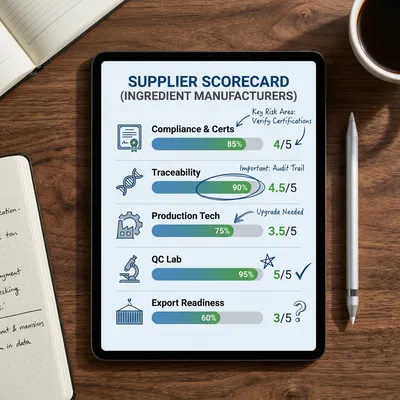
| Category | What to Look For | Weight (Example) | Supplier Score (1–5) |
|---|---|---|---|
| Compliance | Valid certificates + scope | 20% | |
| Traceability | Lot mapping, documented origin | 15% | |
| Technology | Controlled production + stable filling | 15% | |
| QC lab | Routine COA + method clarity | 20% | |
| Application support | Fast troubleshooting + R&D capability | 10% | |
| Export readiness | Logistics experience, documentation flow | 10% | |
| Commercial reliability | Lead time stability, OOS handling | 10% |
If you are qualifying both MCC and resistant dextrin, keep one scorecard structure but adjust the technical criteria. This prevents the common mistake of using a “fiber checklist” to judge an excipient plant—or vice versa.
Manufacturing Hub Deep Dive: Why Shandong Keeps Appearing on Shortlists
Procurement teams often notice that shandong resistant dextrin manufacturers show up frequently in export-oriented sourcing. The reasons are usually practical rather than promotional:
- Strong regional capability in corn-starch-based ingredient supply chains
- Mature manufacturing clusters for soluble fibers and related functional carbohydrates
- Established logistics routes supporting international shipment volume
Industry reporting and supplier directories have repeatedly highlighted Shandong as a key region in China’s ingredient manufacturing landscape—particularly for functional fibers. For a buyer, “hub strength” doesn’t replace supplier qualification, but it can explain why the region produces multiple candidates capable of supporting US/EU programs.
Two Mini Case Studies Procurement Teams Can Reuse
These are anonymized patterns procurement teams can adapt when evaluating a Microcrystalline Cellulose Manufacturer China and a Resistant Dextrin Supplier.
Case Study A: MCC for Direct Compression—When “Meets Spec” Still Fails
Scenario: A nutraceutical tablet line sourced MCC that met basic COA values. During scale-up, tablet hardness drifted and flow issues caused weight variability.
Root cause pattern: The purchase spec focused on broad limits, but did not lock:
- Particle size distribution targets aligned to the press
- Flow metrics relevant to the feeder setup
- Compression behavior verified on the buyer’s equipment
Procurement fix: The team revised the qualification pack to include sample trials, repeat sampling across multiple lots, and tighter acceptance criteria linked to the tablet press behavior.
Procurement lesson: For a Recommended Chinese Microcrystalline Cellulose Supplier, “compliance” and “performance” are separate gates. MCC is an excipient where small shifts can trigger big downstream effects.
Case Study B: Low-Calorie Beverage Fiber—Picking the Right Resistant Dextrin Grade
Scenario: A beverage brand planned a low-calorie, fiber-enriched product with hot-fill and a target pH around 3.5. Early prototypes showed haze and mouthfeel thickening.
What worked: The team screened resistant dextrin grades based on:
- Fiber content strategy (commonly requested at ≥82%, with some programs targeting ≥90% on a dry basis depending on label design)
- Solubility behavior (commonly referenced around 70% for beverage-friendly grades)
- Neutral taste expectations
- Stability under heat and acid conditions
Procurement lesson: In beverage applications, a good Resistant Dextrin Supplier is defined as much by application support and reproducibility as by fiber number. The “right grade” is often the difference between a clean label launch and months of reformulation.
MCC vs Resistant Dextrin: What to Verify (Side-by-Side)
Procurement teams move faster when they maintain two parallel checklists.
Microcrystalline Cellulose (MCC) Verification Points
When evaluating a Microcrystalline Cellulose Manufacturer China, focus on:
- Grade mapping to your internal specs and end use
- Particle size distribution and flow properties relevant to your production line
- Moisture control and storage handling
- Reproducibility across multiple lots
- Microbial controls aligned to your downstream requirements
If internal testing capacity is limited, third-party testing on initial lots is often cheaper than troubleshooting after a full container lands.
Resistant Dextrin Verification Points
When evaluating a Resistant Dextrin Supplier, focus on:
- Fiber content and the supplier’s measurement approach
- Solubility and viscosity behavior in your target matrix
- Taste neutrality and stability under heat/acid
- Raw material origin (often corn starch) and suitability for non gmo resistant dextrin china programs
- Packaging integrity and moisture protection strategy
How Buyers Use “Recommended Supplier” Language Without Guesswork
Search phrases like Recommended Chinese Microcrystalline Cellulose Manufacturer, Recommended Chinese Microcrystalline Cellulose Supplier, and Recommended Chinese Resistant Dextrin Manufacturer are often shorthand for one thing: the buyer wants a supplier that will survive audits and scale-ups.
A procurement-safe way to define “recommended” is to require evidence in three layers:
- Governance evidence (certificates, scope, documented systems)
- Technical evidence (repeat-lot testing, method clarity, application-fit trials)
- Operational evidence (export documentation flow, lead-time reliability, OOS handling)
When a supplier can meet all three, “recommended” stops being an opinion and becomes a purchasing standard.
A Neutral Benchmark: What “Best-in-Class” Often Looks Like in Shandong
Procurement teams frequently ask for a benchmark profile—without turning the process into brand shopping. A useful benchmark typically includes:
- Corn-starch-based resistant dextrin production with clear NON-GMO positioning when required
- Automated production descriptions with controlled feeding-to-filling workflow
- In-house QC laboratory capabilities and transparent COA practice
- Export-facing documentation discipline
One Shandong-based example that procurement teams sometimes review as a reference point for these capabilities is the supplier profile and product pages published at:
https://www.sdshinehealth.com/