
How to Vet Chinese MCC & Resistant Dextrin Suppliers in 2025 (Without Getting Burned)
China remains the strategic center for global sourcing of microcrystalline cellulose (MCC) and resistant dextrin in 2025. For procurement teams prioritizing scale, pricing flexibility, and a deep supplier base, the advantages are clear: mature industrial clusters, robust export logistics, and factories capable of delivering container volumes with consistent lead times.
However, risks persist. In the MCC sector, claims of "pharma-grade" compliance face increasing scrutiny, and the quality of technical documentation can vary significantly between suppliers. For resistant dextrin, buyers often encounter challenges such as inconsistent clarity or viscosity in beverages, mismatched labeling claims regarding non-GMO status or fiber content, and incomplete traceability records.
A rigorous supplier evaluation process—anchored in precise specifications, manufacturing controls, and document verification—is the key to transforming China’s cost advantage into a dependable, long-term supply chain.

The 2025 China Supply Landscape
The supply landscape for microcrystalline cellulose (MCC) and resistant dextrin in China acts less like a single national market and more like a collection of regional capability clusters. Buyers will find a high concentration of capacity, equipment investment, and process expertise in specific provinces—with Shandong frequently emerging as a primary hub for both functional fibers and pharmaceutical excipients.
For MCC, the sector has evolved toward stricter quality expectations driven by regulatory pressure. Market intelligence indicates a mature industry where high-end compliance is now the baseline, requiring sustained capital investment and consistent GMP execution from manufacturers.
Regarding resistant dextrin, China continues to be a dominant origin for starch-derived soluble fibers (predominantly corn-based). The market offers a diverse range of grades tailored for beverages, bakery products, meal replacements, and dietary supplement powders.
Ingredient Basics: Defining Performance Expectations
Procurement failures often stem from treating MCC and resistant dextrin as generic commodities. They are functional ingredients where performance is tied to specific, measurable parameters. Even minor deviations can significantly alter behavior in tablets, beverages, or powder blends.
Microcrystalline Cellulose (MCC): Fit and Function
Microcrystalline cellulose (MCC) serves primarily as an insoluble cellulose powder in formulations requiring consistent flow, compressibility, or physical stability. Two grades with identical "headline" specifications can perform differently on a production line if particle size distribution, bulk density, and moisture content are not tightly controlled.
Common procurement use cases for MCC:
- Pharma and nutraceutical tablets: Acts as a binder/filler and disintegrant aid.
- Capsules: Functions as a diluent and processing aid.
- Food and cosmetics: Used for texture modification, stabilization, and anti-caking (grade-dependent).
Resistant Dextrin: Fiber Fortification and Product Feel
Resistant dextrin is a soluble dietary fiber produced from starch through controlled processing. It is sourced to deliver fiber fortification with minimal impact on taste and high formulation flexibility. In many commercial grades, suppliers emphasize its ability to resist digestion in the small intestine and ferment in the large intestine, making it a staple in modern gut-health product concepts.
Common procurement use cases for resistant dextrin:
- Clear beverages and drink mixes: Demands high clarity and flavor neutrality.
- Meal replacements and nutrition powders: Balances nutritional profile with solubility.
- Baked goods and confectionery: Increases fiber content while maintaining mouthfeel.
- Low-sugar and keto products: Critical for managing net carb impact.

Specification Reality Check: The Critical COA Parameters
A Certificate of Analysis (COA) is only valuable if its parameters predict success in your specific application. Below are practical checklists mapping specification items to real-world import risks and formulation performance.
Resistant Dextrin COA Checklist (Food & Supplements)
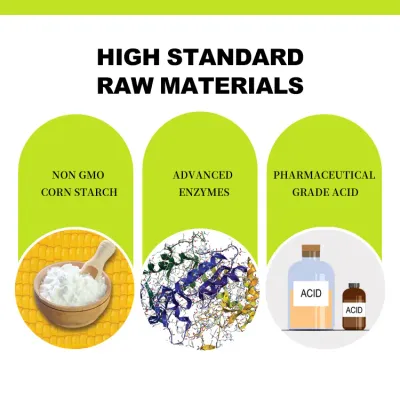
Most factory-grade resistant dextrin from China is positioned as a soluble fiber ingredient derived from non-GMO corn starch. Typical specifications focus on fiber content, moisture control, and microbiological safety.
Key parameters for your RFQ:
| Parameter | Why it matters | Typical Market Target |
|---|---|---|
| Fiber Content | Validates label claims and dosage. | Commonly ≥82% (some dry-basis claims are higher) |
| Appearance | Predicts consistency in final products. | White to light yellow powder |
| Moisture | Critical for anti-caking and storage stability. | Often ≤5% (grade dependent) |
| pH (Solution) | Affects beverage stability and taste. | Acidic-to-neutral band (method dependent) |
| Water Activity | Indicator of shelf-life and microbial risk. | Often targeted low (e.g., ≤0.2) |
| Solubility | Determines clarity and processing speed. | Validate in your specific matrix |
| Microbiology | Essential hygiene control. | APC ≤1000 CFU/g; Yeast/Mold ≤25 CFU/g |
Note: "Solubility" reporting varies. Some suppliers list partial solubility while others claim full solubility. Always treat this as an item for internal application testing rather than just a document check.
MCC COA Checklist (Nutraceutical & Pharma)
For microcrystalline cellulose, the standard depends heavily on the end use. While food-grade MCC suffices for some applications, pharmaceutical excipients demand higher documentation maturity and rigorous process control.
Critical MCC parameters to verify:
- Identification: Confirms compendial alignment; vital for regulated markets.
- Particle Size Distribution: Dictates flow, compressibility, and tablet uniformity.
- Bulk / Tapped Density: Predicts mixing behavior and tablet weight consistency.
- Loss on Drying (LOD): Impacts stability and processing.
- Residue on Ignition: Controls purity and inorganic residue.
- Microbial Limits: Safety baseline for oral consumption.
Note: For pharmaceutical applications, compliance goes beyond "GMP on paper." Verify site systems, change control protocols, and batch traceability.
Supplier Evaluation Framework: Beyond the Price Tag
Most sourcing issues with resistant dextrin and MCC arise from verification gaps rather than negotiation failures. A structured evaluation framework is the best defense against low-cost surprises.
1) Certifications: Check Relevance, Not Just Logos
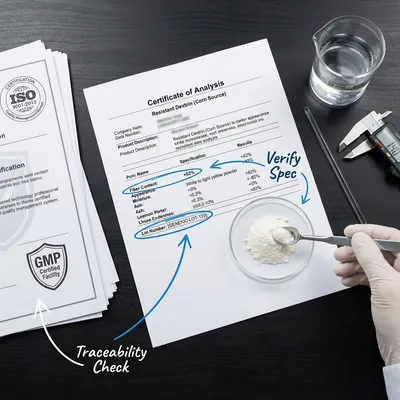
Credible suppliers must provide certifications matching your market channel. Look for ISO 9001 for management, HACCP/ISO 22000 for food safety, and relevant GMP standards for pharma/nutra use. If your product claims Non-GMO, ensure the corn starch source is explicitly covered. Always cross-reference the site address on certificates with export documents.
2) Traceability: The Story Behind the Batch
Traceability is the primary risk point for non-GMO claims. A reliable supplier must support batch-level traceability from starch intake to the finished resistant dextrin lot. If a supplier says they "can try" to find upstream records rather than having them readily available, consider it a red flag.
3) Automation and Process Control
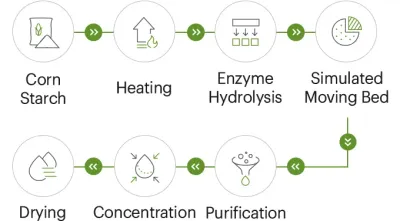
Automation is a strong proxy for product consistency. For resistant dextrin, leading suppliers utilize automated central controls from feeding to filling. If a supplier cannot clearly explain how process deviations (like temperature or moisture endpoints) are managed, anticipate lot-to-lot variation in your final product.
4) Lab Capabilities: Testing is Control
Lab capability is non-negotiable. At a minimum, verify that the supplier has a functioning in-house QC lab for routine checks and a consistent COA template. If a supplier only offers trading documents without technical support, they are selling paper, not a controlled ingredient.
Buying Workflow: From RFQ to Scale-Up
A robust sourcing system is designed to be boring on paper so that it prevents drama in production.
- Define Application First: Establish whether you need resistant dextrin for a clear beverage or MCC for direct compression. This sets your COA baseline.
- Standardized RFQ: Don't accept disparate PDFs. Ask suppliers to fill in your data table for direct comparison.
- Document-Based Shortlist: Filter suppliers based on the completeness and clarity of their technical documentation.
- Application Testing: Validate dispersibility, clarity, and taste for dextrin; check flow and compaction for MCC. This step is often under-budgeted but critical.
- Remote Audit: Before the pilot order, request a structured walkthrough of raw material storage, production lines, and the QC lab.
- Quality Agreement: Lock in critical specs, change control notification, and complaint response timelines.
- Controlled Scale-Up: Start with a pilot, then scale in increments. Two consistent shipments are a good benchmark before full-scale integration.

Commercial Reality: Why "Cheapest" Can Cost More
While unit price is important, the total landed cost reveals the true value. Factors like freight class, palletization quality, and documentation accuracy (affecting customs clearance) play a huge role. Suppliers offering factory-direct MOQs and price breaks for volume can significantly lower long-term costs compared to trading offers.
Identifying Reliable Partners
When evaluating potential partners, look for signals that correlate with performance: deep technical understanding of application differences, consistent COAs, proven traceability for non-GMO claims, and responsive audit support.
For buyers seeking a shortlist of factory-based manufacturers with transparent production processes and detailed product data, producers like Shandong Shine Health Co., Ltd are worth evaluating. Their focus on functional ingredients and pharmaceutical excipients aligns with the rigorous standards discussed in this guide.
Procurement Checklist (MCC + Resistant Dextrin)
- Confirm Application: Beverage, tablet, food, or supplement?
- Standardize COA: Ensure all suppliers quote to the same specs.
- Verify Claims: Request non-GMO and traceability proofs.
- Check Recent Lots: Ask for actual recent COAs, not just a sample template.
- Audit Scope: Match certificate addresses to the manufacturing site.
- Test Performance: Verify clarity, viscosity, or compression in-house.
- Remote Audit: Inspect the process flow from raw material to packaging.
- Pilot First: Start with conservative commercial terms.
- Quality Agreement: Sign before scaling up.
- Monitor: Track OTD, complaint rates, and responsiveness continuously.