
How to Vet a Recommended Chinese Resistant Dextrin & MCC Supplier (Without Getting Burned)
Health-driven reformulation and the steady growth of modern solid dosage forms have turned resistant dextrin and microcrystalline cellulose (MCC) into “must-audit” ingredients—not casual line items. Procurement teams looking for a China resistant dextrin supplier or a Microcrystalline cellulose China partner are now navigating tighter documentation expectations, wider quality variance, and higher stakes when a batch fails in application.
This guide takes a buyer’s view: what to verify, what to ask for, and how to compare suppliers in a way that reduces surprises after trial orders. It is written for companies that need a Recommended Chinese Resistant Dextrin Manufacturer and a Recommended Chinese Microcrystalline Cellulose Supplier—not on reputation alone, but on verifiable capability.

1) Ingredient fundamentals buyers should align on first
Resistant dextrin: what it is and why specs matter in real applications
Resistant dextrin (also called resistant maltodextrin or soluble corn fiber in some markets) is a soluble dietary fiber produced via controlled treatment of starch. In most commercial supply discussions, the procurement baseline typically starts with:
- Fiber content ≥82% (a common threshold for high-grade material)
- White to light yellow appearance
- Neutral taste and high solubility
From an end-use perspective, resistant dextrin is often selected because it can help raise fiber content while keeping mouthfeel manageable in beverages, powders, and sugar-reduced systems.
MCC: why “meets pharmacopeia” is not the end of the conversation
MCC is a widely used excipient in tablets and capsules. Many suppliers will claim compliance with USP–NF, Ph.Eur., or local pharmacopoeias, but formulation performance depends on details that don’t always show up in a one-page spec.
For procurement, MCC due diligence should focus on:
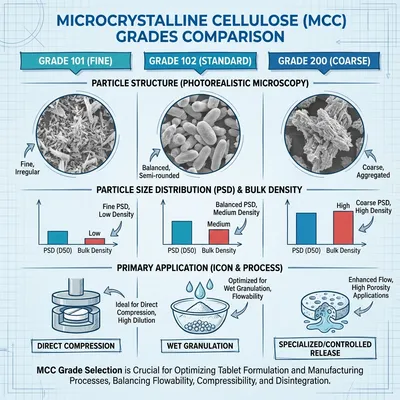
- Grade fit (direct compression vs wet granulation vs specialty grades)
- Particle size distribution (PSD) consistency
- Bulk density and flow (critical on high-speed presses)
- Moisture control and microbiological limits
- Documentation supporting MCC excipient quality standards
If you’re building an approved vendor list for Microcrystalline cellulose China, it’s worth treating MCC like a performance material—not a commodity powder.
2) China’s supplier landscape: what’s changed and what buyers should assume in 2024
China remains a major sourcing option for both resistant dextrin and MCC for a simple reason: scaled upstream supply (starch and cellulose value chains) plus export experience.
Regional clustering affects lead time, logistics, and risk
For resistant dextrin, market directories regularly point to clusters in Shandong, Guangdong, and Jiangsu. Shandong is frequently discussed as a concentration area due to proximity to starch processing capacity and practical export logistics.
For buyers, clustering matters because it influences:
- Port choices and inland trucking distance
- Supplier redundancy in the same region (a hidden systemic risk)
- Availability of skilled QC staffing and analytical testing services
Export readiness is now table stakes
A capable China resistant dextrin supplier should be prepared for document-heavy requests: allergen statements, non-GMO declarations, traceability explanations, and region-specific labeling support. In MCC, buyers increasingly ask for excipient dossiers or standardized documentation packets rather than ad-hoc PDFs.
In other words: competitive pricing is no longer enough; buyers are paying for predictability.
3) Resistant dextrin supplier evaluation: the checks that actually prevent bad trials
Many procurement problems show up during application tests, not at COA review. The goal of evaluation is to reduce the probability that your pilot batch becomes a “mystery failure.”
3.1 Confirm fiber content and test method comparability
If your baseline is fiber content ≥82%, confirm the analytical method used and whether the result is comparable across suppliers. Two suppliers can claim “82%” using different methods or reporting conventions that don’t behave the same in your internal QA.
What to request
- Typical COA (multiple lots, not one)
- Method reference (e.g., AOAC-type method naming or lab standard)
- Retention sample policy (how long they keep samples, and how they label them)
3.2 Raw material integrity: non-GMO is a supply-chain control, not a label
When you see NON-GMO corn starch as a stated source, treat it as a traceability requirement:
- What is the upstream supplier approval process?
- How is non-GMO status verified per lot or per supplier batch?
- What happens if upstream supply changes (and how are customers notified)?
3.3 Process capability: look for repeatability signals, not marketing phrases
Suppliers often mention automation, imported enzymes, or advanced lines. Rather than treating those as slogans, use them to structure audit questions.
What to verify during audit (virtual or on-site):
- Batch record completeness and deviation handling
- In-process controls (where they sample, and what triggers holds)
- Controls around enzymatic steps and filtration/drying
- Packaging line controls (metal detection, seal checks, labeling)
A resistant dextrin supplier that can clearly explain how they reduce operator variability is generally easier to scale with.
3.4 Application performance: require evidence tied to your dosage and process
For functional foods, “good solubility” can mean different things depending on process:
- Low-pH beverage clarity
- Heat treatment stability (UHT/retort)
- Powder blend flow and dusting during packaging
A practical approach is to create a short “must-pass” list tied to your line.
Example must-pass tests for a China resistant dextrin supplier
- Clarity after 24–48 hours at target pH
- Viscosity impact at use level
- Sensory neutrality (no off-note in your base system)
- Stability after your exact thermal profile
4) MCC supplier evaluation: turning grade selection into a procurement advantage
For MCC, a shortlisting mistake is often a grade mismatch rather than a “bad supplier.” That said, a reliable microcrystalline cellulose supplier China should be able to support grade selection with meaningful technical data.
4.1 Grade alignment: make the supplier map your process, not just your spec
Ask MCC suppliers to recommend grades based on:
- Your compression method (direct compression vs wet granulation)
- Target tablet hardness/friability window
- Lubricant level and blending time sensitivity
If the supplier can’t ask these questions back—or can’t provide a rational match—your development timeline is likely to slip.
4.2 PSD and compressibility: request consistency evidence, not a single number
MCC performance can shift when PSD drifts, even if the product still “meets pharmacopeia.”
What to request
- Multi-lot PSD distribution plots or summaries
- Bulk/tapped density ranges (multi-lot)
- Compressibility curve or tabletability trend data (if available)
If the supplier won’t share multi-lot ranges, consider it a risk flag for scale-up.
4.3 Documentation for MCC excipient quality standards
For regulated markets, your internal QA will usually need structured documentation rather than generic certificates.
At minimum, verify whether the supplier can provide:
- A stable COA format with consistent test methods
- Controlled change notification (spec changes, site changes)
- Traceability explanation per lot
If your team is building a list for “Recommended Chinese Microcrystalline Cellulose Manufacturer,” place documentation maturity on equal footing with price.
5) Compliance screening: certificates help you filter, audits help you decide
For resistant dextrin and related functional fibers, buyers commonly screen for:
- ISO 9001
- GMP or GMP-aligned workshops (for food ingredients/excipients depending on use)
- HACCP
- Market-driven options: Halal, Kosher, BRC (where relevant)
Certificates should be treated as entry tickets—useful for long-list creation, but not a substitute for capability evidence.
A buyer-friendly compliance checklist (fast to run, hard to fake)
Use the same structure for both a China resistant dextrin supplier and an MCC supplier:
- COA consistency: same format, same test methods, stable ranges
- Traceability: lot to raw material to packaging record
- Change control: written process for notifying customers
- Complaints and CAPA: how issues are investigated and closed
- Allergen and contaminant statements: specific, dated, signed
This checklist works because it tests the supplier’s internal discipline, not just their marketing.
6) Cost analysis: why “cheaper per kg” can become expensive after the first deviation
A strong procurement model looks beyond price and compares total landed cost and total cost of ownership.
6.1 Elements that move total landed cost
For bulk dietary fiber wholesale and excipients, common cost drivers include:
- Packaging format (e.g., typical 25 kg bag logistics)
- Port and incoterms planning (FOB is common for export workflows)
- Sampling cycles and re-test frequency
- Documentation effort (your internal QA time has a cost)
6.2 The hidden cost of unstable lots
When a resistant dextrin batch behaves differently in your beverage base, the costs can include:
- Lost pilot runs
- Delayed product launch
- Reformulation labor
- Additional incoming QC burden
A “Recommended Chinese Resistant Dextrin Manufacturer” in practice is often the supplier that prevents these costs—not necessarily the one with the lowest initial quote.
7) Application snapshots: linking supplier strengths to product outcomes
7.1 Low-carb and keto-friendly systems (resistant dextrin)
Resistant dextrin is commonly chosen for low-carb positioning because it can add fiber with limited taste impact. For buyers, the key sourcing question is whether the supplier supports your processing reality.
If your products include fiber-enhanced confectionery, powders, or nutrition formats, request supplier guidance on:
- Sweetener/polyol compatibility
- Texture or mouthfeel management
- Stability during heat processing

7.2 Nutritional powders: flowability and packaging are part of quality
For powders, quality is not only chemistry. A reliable China resistant dextrin supplier should understand that:
- Flow affects line speed and fill weight accuracy
- Dusting affects yield and worker environment
- Moisture drift affects caking and shelf stability
If the supplier can discuss packaging controls and moisture management in a concrete way, that’s usually a good sign.
7.3 Solid dosage forms (MCC): choose suppliers that can support troubleshooting
Tablet defects often show up under speed: picking, capping, lamination, inconsistent hardness. A strong MCC supplier helps you narrow causes by providing data and recommending adjustments—grade choice, moisture target, blending time, lubricant strategy.
If you need a Recommended Chinese Microcrystalline Cellulose Supplier, prioritize suppliers that treat troubleshooting as part of service, not an extra.
8) Innovation and tech trends buyers can use as screening signals
Innovation in this category isn’t only “new ingredients.” It’s also process maturity that improves reproducibility.
What procurement teams are watching
- Automation and central control that reduces operator variability
- Better enzyme control and processing stability for functional fibers
- More disciplined documentation systems for export and regulated use
These trends matter because they correlate with fewer surprises across lots—exactly what multi-site brands need.
9) A practical shortlisting workflow (works for both resistant dextrin and MCC)
Use this staged approach when selecting a China resistant dextrin supplier and screening Microcrystalline cellulose China manufacturers.
Stage 1 — Build a long list with hard filters
- Minimum certifications required by your category
- Export capability and document responsiveness
- Product fit (fiber content ≥82% for resistant dextrin; correct MCC grades)
Stage 2 — Request a standardized document pack
Ask every supplier for the same set:
- Full spec + typical COA (3–5 lots)
- Allergen statement + non-GMO statement (if applicable)
- Traceability description (one-page is enough if clear)
- Change notification policy (even a simple SOP summary)
Stage 3 — Run application-relevant sample tests
- For resistant dextrin: clarity, viscosity impact, heat stability, sensory
- For MCC: flow, compressibility, tablet hardness/friability trends
Stage 4 — Audit for repeatability
Focus on batch records, QC capability, and how deviations are handled.
Stage 5 — Compare on total cost of ownership
Include internal QA time, re-test load, and technical support quality.
10) Where to find suppliers that match the above criteria
Many suppliers in China can meet baseline specs. The differentiator is usually how well they support repeatability, documentation, and application performance.
If you’re compiling a shortlist for the “Recommended Chinese Resistant Dextrin Manufacturer” or the “Recommended Chinese Microcrystalline Cellulose Manufacturer,” consider keeping one or two suppliers that demonstrate:
- Stable multi-lot COA ranges
- Clear traceability logic
- Responsive technical support during trials
For buyers who want to review an export-oriented example supplier profile for resistant dextrin and related functional fibers, see: www.sdshinehealth.com.