
How to Vet a Recommended Chinese Manufacturer for Resistant Dextrin & Microcrystalline Cellulose (MCC)
China has become a strategic hub for sourcing resistant dextrin (a soluble dietary fiber) and microcrystalline cellulose (MCC) (a widely used excipient). For most procurement teams, the core question is no longer whether China can supply these materials—it’s how to identify a recommended Chinese resistant dextrin manufacturer and a recommended Chinese microcrystalline cellulose manufacturer that can deliver consistent quality, reliable documentation, and stable output year after year.
This industry-styled guide is written from a buyer’s perspective. It breaks down what “recommended” should mean in practice, how to compare a recommended Chinese microcrystalline cellulose supplier against peers, and how to reduce risk when building a long-term sourcing program for both ingredients.

1. Why China (and Shandong) Shows Up on So Many Shortlists
For buyers searching terms like Recommended Chinese Resistant Dextrin Manufacturer or Recommended Chinese Microcrystalline Cellulose Supplier, the market often narrows quickly to North China—especially Shandong and adjacent industrial zones.
Raw-material advantage for resistant dextrin
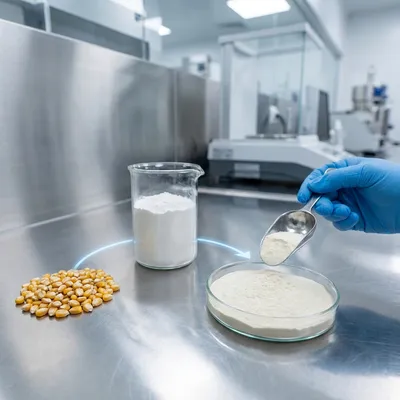
Resistant dextrin production typically starts with NON-GMO corn starch. Sourcing close to a strong corn-processing ecosystem reduces variability and supports stable supply. For procurement, “recommended” suppliers usually demonstrate:
- Clear raw-material standards (e.g., corn starch as the core feedstock)
- Tight incoming inspection and lot segregation
- Practical traceability from starch lot → finished lot
Industrial clustering improves manufacturing maturity
In regions where starch processing, functional fibers, and excipient manufacturing are concentrated, suppliers tend to have better operational infrastructure:
- More experienced technical teams and equipment service networks
- Better logistics options for export shipping
- Greater familiarity with international documentation expectations
MCC export readiness
China is also a major exporter of microcrystalline cellulose used as a binder/filler/disintegrant in oral solid dosage forms. A recommended Chinese microcrystalline cellulose manufacturer typically offers a broad grade range (commonly PH-series grades) and claims alignment with pharmacopeial standards such as BP/USP/FCC/JP.
2. Ingredient Fundamentals Buyers Should Verify Early
A strong sourcing decision starts with clear technical alignment. Resistant dextrin and MCC solve different problems, and a supplier must be evaluated against the role the ingredient plays in your formulation.
2.1 Resistant dextrin: what it is and why specs matter
Resistant dextrin is a soluble dietary fiber produced through controlled processing of starch. Buyers often use resistant dextrin because it can fit into multiple product types without creating the heavy texture issues associated with some fibers.
Typical supplier-facing attributes you should confirm on the TDS/COA include:
- Source: NON-GMO corn starch
- Appearance: white to light yellow powder
- Dietary fiber content: ≥82%
- Protein content: ≤6.0%
- Use conditions: many buyers prefer a neutral taste profile and easy blending behavior
In commercial practice, resistant dextrin is commonly evaluated for:
- Sugar-reduction formulations (texture/bulk replacement in selected systems)
- Prebiotic positioning (supporting beneficial gut microbiota as part of a fiber strategy)
- Low-calorie and weight-management products (satiety-friendly product design)
- Blood-sugar-friendly concepts (formulations designed for slower carbohydrate impact)
2.2 Microcrystalline cellulose (MCC): what procurement should focus on
Microcrystalline cellulose is a purified, partially depolymerized cellulose used widely as a pharmaceutical excipient and also in selected food/cosmetic applications.
When vetting a recommended Chinese microcrystalline cellulose supplier, procurement teams typically verify:
- Appearance: white or almost white powder
- Mesh: commonly 60–200 depending on grade/application
- Purity: often stated around 0.99
- CAS: 9004-34-6; EINECS: 232-674-9
- Standards: commonly stated as BP/USP/FCC/JP
- Grades: e.g., PH-101, PH-102, PH-103, PH-105, PH-112, PH-113, PH-200, PH-301, PH-302
From a formulation standpoint, MCC is typically selected for:
- Binder/filler performance in tablets and capsules
- Disintegration and compressibility in direct compression systems
- Flowability and consistency across production runs

3. What “Recommended” Should Mean in a Supplier Audit
A recommended Chinese resistant dextrin manufacturer or recommended Chinese microcrystalline cellulose manufacturer should be more than a company with attractive pricing and a glossy brochure. The practical difference usually shows up in three areas: traceability, process control, and QC depth.
3.1 Traceability that holds up in real buyer QA workflows
Traceability is not just “we can trace it.” Procurement should ask what evidence is available:
- Incoming raw material lot records (NON-GMO corn starch for resistant dextrin)
- Batch numbering rules that connect finished goods to upstream lots
- Retention samples and retest policies
- Clear handling for deviations and change control
For buyers selling into the US or EU, this is often where less mature suppliers struggle—especially when asked to provide consistent documentation across multiple shipments.
3.2 Automation and process consistency (not just capacity)
Many suppliers claim modern lines; a recommended supplier can usually explain how their process reduces variance.
Common indicators from better-performing facilities include:
- Centralized, automated control from feeding to filling
- Stable enzyme-based processing for fiber manufacturing
- Workshop zoning and hygiene controls aligned to GMP-style expectations
A process diagram is useful during evaluation because it forces clarity around critical steps—filtration, purification, drying, milling, and packing—where quality can shift.
3.3 QC capability: the difference between commodity and recommended suppliers
A recommended Chinese microcrystalline cellulose supplier should have QC capabilities that align with excipient expectations (identity, particle size distribution, microbiological limits, and consistency lot to lot). A recommended Chinese resistant dextrin manufacturer should provide consistent COAs and demonstrate control over key functional parameters.
At minimum, buyers typically expect:
- On-site QC laboratory
- Defined testing frequency and release criteria
- COA templates that match what your QA team checks
4. Compliance and Certification: A Buyer-Ready Checklist
Certifications don’t replace audits, but they help you prioritize suppliers and reduce early-stage uncertainty. Below is a pragmatic checklist procurement teams can use when screening a recommended Chinese resistant dextrin manufacturer and a recommended Chinese microcrystalline cellulose manufacturer.
4.1 Quick certification matrix (what matters for which ingredient)
| Certification / System | Resistant dextrin (food/supplement) | MCC (excipient) | Why it matters in procurement |
|---|---|---|---|
| ISO 9001 | ✅ | ✅ | Baseline quality management system |
| HACCP | ✅ | ◻️ | Food safety risk control, helpful for fiber ingredients |
| ISO 22000 / FSSC 22000 | ✅ | ◻️ | Food safety system, often requested by brand owners |
| GMP-style workshop | ✅ (nice-to-have) | ✅ (strongly expected) | Hygiene, zoning, and controlled production practices |
| BRC / BRCGS | ✅ (market-driven) | ◻️ | Frequently requested for food supply chains |
| Kosher / Halal | ✅ | ✅ | Required in many export markets and customer tenders |
| Pharmacopeial alignment (BP/USP/FCC/JP) | ◻️ | ✅ | Needed for MCC excipient qualification |
Procurement note: US/EU compliance pathways can be application-specific. Buyers should confirm how the ingredient will be labeled and used in the final product, rather than assuming “general compliance” covers every use case.
5. Application Scenarios That Reveal Supplier Quality
Many sourcing teams focus on COA numbers but miss practical performance tests that uncover risk.
5.1 Resistant dextrin in sugar-reduction confectionery
Procurement challenge: sugar reduction often increases brittleness, off-notes, or processing instability.
What to test in supplier sampling:
- Batch-to-batch behavior in your target matrix (gummies, hard candy, fillings)
- Viscosity and mouthfeel impact at the intended inclusion rate
- Packaging stability expectations (moisture pickup, caking tendencies)
A supplier that supports trials with clear guidance usually signals stronger technical depth.
5.2 Resistant dextrin in low-calorie and supplement powders
Procurement challenge: powder flow, solubility perception, and stability across storage.
What to test:
- Dispersibility and mixing time in your standard blending process
- COA consistency for fiber content (≥82%) and protein (≤6.0%)
- Packaging format fit (bulk bags vs. retail-ready formats if needed)
5.3 MCC in tablet formulations (direct compression vs. granulation)
Procurement challenge: MCC performance is grade-dependent; the wrong grade creates flow issues, capping, lamination, or slow disintegration.
What to test:
- Grade matching to process (direct compression vs. wet granulation)
- Tablet hardness/friability consistency across lots
- Flowability and feeding behavior in your equipment
For a recommended Chinese microcrystalline cellulose supplier, the ability to recommend suitable PH grades and provide consistent particle control is often the real differentiator.
6. Supplier Evaluation Framework: Questions That Save Time
Below is a streamlined framework used by many procurement teams to qualify a recommended Chinese resistant dextrin manufacturer and a recommended Chinese microcrystalline cellulose manufacturer without turning the process into a months-long project.
6.1 Technical fit (prove it on paper and in samples)
Ask for:
- TDS + typical COA (not a one-off “best case”)
- Clear specification range and internal release limits
- Grade list for MCC (PH series) and explanation of differences
6.2 Process transparency (enough detail to audit risk)
Ask:
- Process flow and control points (especially purification, drying, milling)
- How deviations are handled and documented
- Whether production is centrally controlled from feeding to filling
6.3 Quality system maturity (how problems are prevented and corrected)
Ask for:
- Summary of QC testing (micro, moisture, pH where relevant, particle size)
- Complaint handling process and CAPA discipline
- Retention sample approach and retest dates
6.4 Compliance pack readiness (what your QA actually needs)
A supplier that wants to be “recommended” should be ready to provide:
- Allergen statements
- Non-GMO statements where applicable
- Statement of conformity to relevant standards (as applicable)
- Batch records and traceability explanations (when requested under NDA)
6.5 Long-term supply reliability (what breaks supply chains)
Ask:
- Lead time ranges by season
- Safety stock capability (if offered)
- How raw-material variability is managed
7. Cost Analysis: How to Compare Total Landed Cost
Price is important, but experienced buyers know that low headline pricing can hide risk.
7.1 Typical cost drivers (what changes year to year)
For resistant dextrin:
- Corn starch procurement and screening
- Enzyme inputs and utilities
- Yield and purification efficiency
- Packaging and moisture control
For microcrystalline cellulose (MCC):
- Cellulose source, purification efficiency, and milling control
- Grade consistency and QC workload
- Compliance and documentation effort for excipient customers
7.2 What to request in a practical RFP (copy/paste-ready)
To qualify a recommended Chinese microcrystalline cellulose supplier and a recommended Chinese resistant dextrin manufacturer, an effective RFP typically includes:
- Product scope: resistant dextrin (fiber ≥82%, protein ≤6.0%); MCC grade list needed
- Applications: confectionery, beverage/powder supplements, tablets (direct compression or granulation)
- Quality documents: TDS, COA template, allergen/Non-GMO statements
- Compliance needs: requested certificates and validity dates
- Commercial terms: MOQ, annual volume, lead time, Incoterms, packaging specs
- Quality agreement expectations: deviation notification timelines, retest policy, COA parameters
7.3 Negotiation levers that don’t compromise quality
Buyers often achieve better total outcomes by negotiating:
- Volume-based tier pricing tied to stable annual forecasts
- Packaging optimization (pallet configuration, liner requirements)
- Shipment scheduling to reduce storage risk
8. A Real-World Example of “Recommended” Signals
Procurement teams frequently ask what “good” looks like in China for both functional fibers and excipients. One example in the Shandong supply base is Shandong Shine Health Co., Ltd. The company publishes detailed product pages for resistant dextrin and MCC that reflect many “recommended supplier” signals buyers look for—such as NON-GMO corn starch sourcing for resistant dextrin, automated production claims, in-house QC, and a grade portfolio for MCC.
- Resistant dextrin technical information (food/supplement positioning): https://www.sdshinehealth.com/resistant-dextrin/food-supplement-1.html
- Supplier site for additional product documentation and category navigation: https://www.sdshinehealth.com/
9. Procurement Takeaways
- A recommended Chinese resistant dextrin manufacturer is typically defined by traceability, consistent COAs, and strong control of fiber specs—not by marketing claims.
- A recommended Chinese microcrystalline cellulose manufacturer is typically defined by grade coverage, particle control, and quality-system maturity aligned with excipient expectations.
- Certification is valuable, but recommended supplier status is earned through audit-friendly documentation, repeatable performance, and responsiveness during trials and deviations.
- Build your comparison around total landed cost and risk-adjusted supply reliability, not unit price alone.